The story of modern electronics is often credited to towering figures who reshaped the world with bold theories and dramatic inventions. But sometimes, progress comes from a quieter, more deliberate mind—one that sees how existing ideas can be shaped into something entirely new. John Ambrose Fleming was that kind of innovator. His invention of the vacuum tube diode, the first true electronic device, marked a turning point that bridged the age of radio-wave discovery with the emerging world of electronic circuits and amplification. His work not only influenced wireless communication but laid the groundwork for the vast network of electronic systems we rely on today.
Early Life and the Making of a Thinker
Born in 1849 in Lancashire, England, Fleming grew up during a period when the foundations of electromagnetism were just being laid. Faraday had mapped the invisible landscape of fields; Maxwell had given them mathematical form; and innovators like Hertz and Tesla were beginning to draw electricity and magnetism into the realm of practical technology. Fleming entered this evolving world with a mind tuned to detail, experimentation, and precision.
He pursued studies first at University College London and then at Cambridge, where he became deeply engaged with the emerging science of electromagnetic theory. Unlike some of his more flamboyant contemporaries, Fleming worked steadily, building a reputation as a meticulous experimenter and a thoughtful interpreter of Maxwell’s equations as they applied to real devices.
By the time he became the first professor of electrical engineering at University College London, Fleming had already distinguished himself as a scholar who could bridge theory and practice—a skill that would soon define his greatest contribution.
From Theory to Reality: The Road to the Diode
In the final decades of the 19th century, wireless communication was advancing at an uneven pace. Hertz had demonstrated the existence of radio waves, and Marconi had proved they could send signals across great distances. But there remained a major challenge: detecting radio waves reliably and converting them into usable electrical signals.
Early detectors—coherers, crystal detectors, and various mechanical devices—were inconsistent and delicate. They worked, but they were unstable and prone to noise and interference.
Fleming began examining the issue for the Marconi Company, where he served as a consultant. He turned his attention to incandescent light bulbs, noticing that heated filaments emitted electrons—a phenomenon known as the Edison effect, discovered but not fully understood by Thomas Edison.
Where Edison saw a curiosity, Fleming saw a solution.
In 1904, he designed a two-electrode vacuum tube consisting of a heated filament (the cathode) and a metal plate (the anode). He realized that current could travel in only one direction through this device, allowing it to act as a rectifier that converted radio-frequency oscillations into direct current.
This invention—the Fleming valve, or vacuum diode—became the first true electronic component.
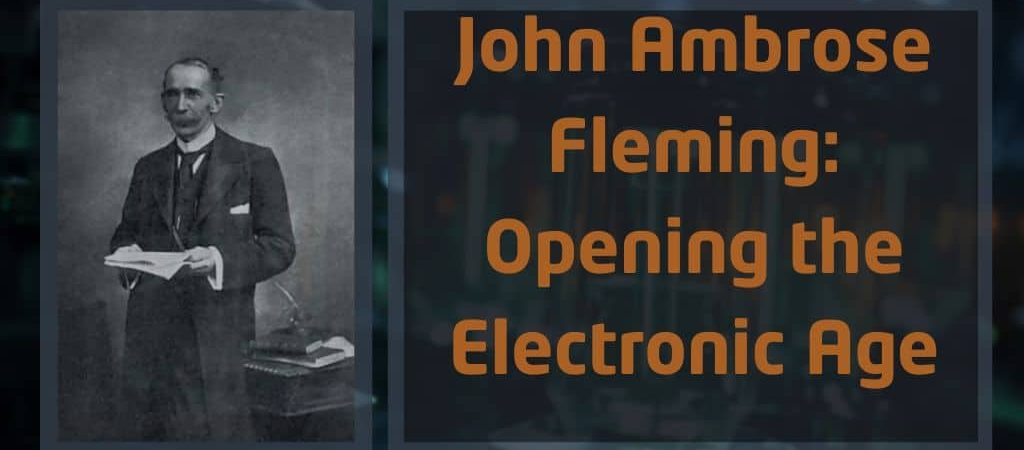
The First Electronic Device
Fleming’s diode was revolutionary because it brought consistency and reliability to wireless communication. For the first time, radio receivers had a dependable method of detecting signals. What had been noisy, uncertain, and mechanically fragile became smooth, predictable, and electrically precise.
More importantly, the diode introduced a new idea: electronics as an independent field of engineering.
Before Fleming, electrical devices were dominated by mechanical switches, coils, and rotating machinery. Fleming’s diode marked the shift from mechanical control of circuits to truly electronic control. The stage was set for amplification, modulation, and the complex signal processing that would define the 20th century.
A Foundation for Modern Electronics
Fleming’s work paved the way for others. Lee de Forest’s triode amplifier, which arrived a few years later, would build directly on the principles established by the diode. Without Fleming, there would be no radio broadcasting, no radar, no early computers, and no electronic control systems as we know them.
His contributions also complemented—and extended—the work of the innovators you’ve already covered in this series:
Faraday revealed the behavior of fields.
Maxwell unified them mathematically.
Hertz proved the existence of electromagnetic waves.
Bose pushed into early radio detection and millimeter waves.
Heaviside expanded the mathematics of signal propagation.
Lamarr imagined frequency-hopping techniques for secure radio.
Fleming, in his own steady way, supplied the missing link between theory and widespread commercial application.
Relevance to Today’s Electronics Environment
What Fleming created was a foundation for everything that followed—circuits, amplifiers, digital logic, and eventually the vast web of connected systems we navigate daily. Even though vacuum tubes have largely been replaced by modern components, the principles Fleming established remain essential:
controlling signal direction
managing noise and interference
stabilizing circuits under fluctuating conditions
rectifying alternating signals into usable forms
These concerns are still central to today’s high-speed communications, 5G/6G devices, aerospace systems, and cloud infrastructure.
As operating frequencies have increased and electronics have become denser and more complex, the importance of handling unwanted radio-frequency energy—EMI/RFI—has only grown. Fleming’s efforts to tame unpredictable signals resonate even more in this era of tightly integrated, high-performance circuits.
Leader Tech and Fleming’s Ongoing Legacy
Although Fleming lived in an age before multilayer PCBs, shielding enclosures, and GHz-band components, his work anticipated many of the challenges that modern engineers now face. Today’s devices must manage signal integrity with far greater precision, and they must also contend with heat, interference, and environmental stresses that early radio pioneers could scarcely imagine.
Leader Tech’s EMI/RFI shielding products and thermal interface materials address many of the same fundamental challenges Fleming confronted—ensuring signals travel in the right direction, remain detectable, and avoid corruption from outside noise. From board-level shields that protect sensitive components to advanced materials that maintain thermal stability in high-density electronics, the spirit of Fleming’s work continues in the engineering solutions used today.
His diode brought clarity to chaotic signals. Modern shielding brings clarity to today’s far more complex environments.
A Quiet Giant of the Electronic Age
John Ambrose Fleming was not the loudest voice in the story of wireless communication, nor the most dramatic. But his insight—that electrons could be guided and controlled with elegance—changed the direction of technology. His invention laid the groundwork for radios, televisions, computers, and the global communications systems that define modern life.
In the long chain of innovators who shaped the electrical world, Fleming’s contribution is small only in appearance. In effect, it opened the gates to everything that came after.