


Clinical laboratories operate at the center of modern healthcare. From diagnosing infections to guiding oncology treatments, lab results influence the majority of medical decisions made today. Because of this, the accuracy and reliability of lab instruments cannot be left to chance. What many people don’t realize, however, is that one of the most persistent threats to laboratory performance is something invisible: electromagnetic interference and radio-frequency interference (EMI/RFI).
Although clinical labs are typically stable, controlled environments, they are also crowded with instrumentation, cabling, automation equipment, computers, and wireless communication devices. This dense concentration of electronics creates ideal conditions for interference. And in a space where measurements often involve extremely small signals—fluorescence detection, impedance shifts, photodiode readings, microfluidic sensors—the margin for error is thin. Even small bursts of EMI/RFI can degrade data quality long before the disturbance becomes obvious.

Why EMI/RFI Matters More in Laboratories Than Ever Before
Clinical laboratories are undergoing rapid modernization. Instruments now feature higher sensitivity, faster digital electronics, and more complex optical systems. Automation platforms shuttle samples between analyzers. Barcode scanners, wireless handhelds, and real-time monitoring dashboards are constantly transmitting data. Each of these advancements improves efficiency and throughput, but together they also increase electromagnetic exposure.
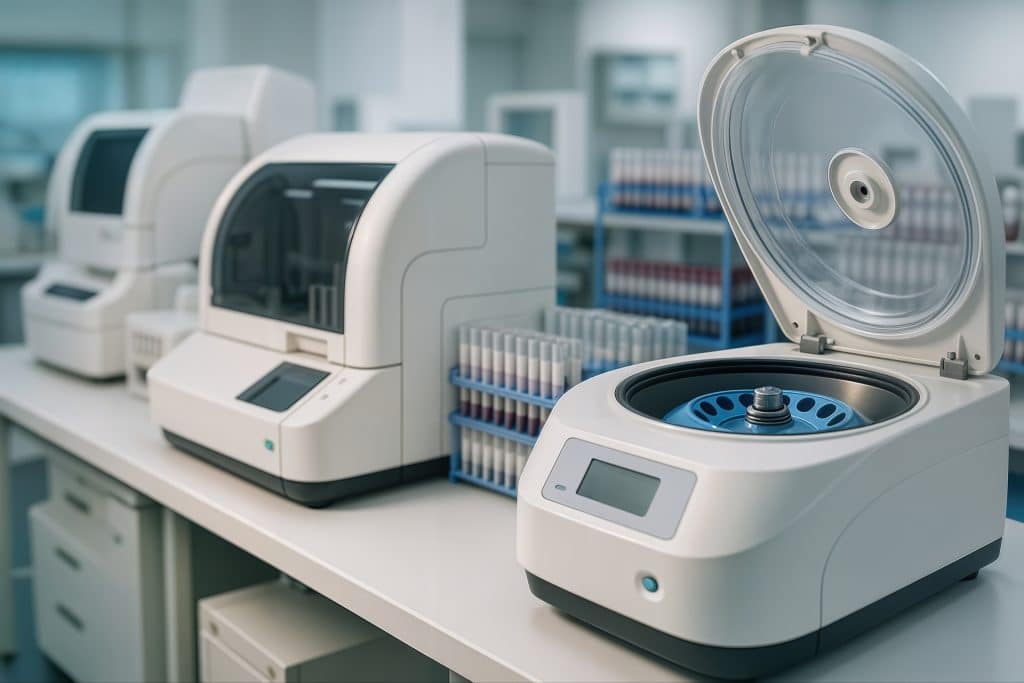
Unlike large imaging systems that are built with robust shielding from the start, many laboratory instruments operate with less protective infrastructure. A hematology analyzer or PCR workstation may sit only a few inches away from another machine that emits a periodic burst of electromagnetic noise. These small, everyday interactions can subtly affect readings in ways that are difficult to trace back to interference.
Even when labs follow standard guidelines, the electromagnetic environment can shift throughout the day: technicians using mobile devices, printers powering up, centrifuges switching speed, or nearby equipment cycling through high-power modes. Labs are dynamic environments, and EMI/RFI risks evolve with them.

Common Sources of Interference in Today’s Labs
EMI/RFI does not require a catastrophic event to cause problems. In fact, most disturbances come from ordinary equipment sources that laboratories depend on every day:
Motors and Pumps
Centrifuges, refrigeration units, HVAC blowers, and peristaltic pumps all generate electromagnetic emissions when switching states or ramping speed. Sudden power changes may create transient noise capable of affecting neighboring analyzers.
Wireless Devices
Wi-Fi routers, Bluetooth peripherals, barcode scanners, and mobile phone traffic introduce RF noise into rooms filled with sensitive electronics. Although low power individually, their proximity to detectors and amplifiers increases cumulative exposure.
Lighting and Power Supplies
LED drivers, fluorescent ballasts, and poorly shielded power supplies emit harmonics that can travel through the air or through shared electrical lines. Instruments relying on optical measurements are particularly vulnerable.
Nearby Diagnostic Systems
PCR instruments, hematology analyzers, and immunoassay systems often operate side-by-side. Each contains its own control boards, robotics, and RF emissions, and over time their interactions can impact baseline stability.
Inadequate Grounding
Even well-designed instruments can underperform if the laboratory’s grounding practices are inconsistent. Ground loops and improper cable routing create additional pathways for interference.
Individually, these sources might not cause noticeable issues. But the modern clinical lab is a dense electromagnetic ecosystem, and the cumulative load can degrade performance in subtle yet meaningful ways.

How EMI/RFI Shows Up in Laboratory Results
Interference rarely announces itself with an obvious error code. More often, it appears as “noise” in the data—brief disruptions that are easily mistaken for instrumentation drift, sample irregularities, or calibration issues.
Some of the most common real-world effects include:

Signal Drift or Baseline Instability
Optical detectors used in spectrophotometry, flow cytometry, and immunoassay platforms are sensitive to small variations. EMI/RFI can shift baseline readings or introduce unexplained drift that affects quantification.
False or Ambiguous Readouts
In coagulation analyzers or impedance-based counters, electromagnetic noise may mimic real events, leading to false flags or unnecessary repeat testing.
Intermittent Calibration Failures
Calibration materials appear “out of range” when the disturbance happens mid-cycle—even though the instrument is functioning normally.
Communication Errors
Automation systems and digital interfaces rely on clean data transfer. EMI/RFI can cause dropped packets, delayed uploads, or interrupted communication with lab information systems.
Unexplained Variability Between Runs
Small anomalies accumulate across shifts or across instruments, affecting reliability even when reagents and procedures remain consistent.
These issues can be easy to overlook, especially when labs are under pressure to deliver fast turnaround times. Yet even minor interference can slow workflows, increase repeats, and ultimately affect clinical decision-making.
Why Laboratory Instruments Are Especially Vulnerable
Clinical lab instruments often rely on weak signals and precision electronics:
- Photodiodes measuring subtle changes in light absorption
- Electrochemical sensors detecting minute current variations
- High-bandwidth ADCs digitizing low-level signals
- Stepper motors and robotic arms relying on stable feedback currents
Because these subsystems operate near the limits of detection, they are inherently sensitive to outside noise. Instrument designers work hard to mitigate this, but the real-world laboratory environment can differ significantly from ideal test conditions.
In other words, even a well-designed analyzer can struggle if the surrounding environment introduces more EMI/RFI than it was originally tested against.

Why Laboratory Instruments Are Especially Vulnerable
Clinical lab instruments often rely on weak signals and precision electronics:
- Photodiodes measuring subtle changes in light absorption
- Electrochemical sensors detecting minute current variations
- High-bandwidth ADCs digitizing low-level signals
- Stepper motors and robotic arms relying on stable feedback currents
Because these subsystems operate near the limits of detection, they are inherently sensitive to outside noise. Instrument designers work hard to mitigate this, but the real-world laboratory environment can differ significantly from ideal test conditions.
In other words, even a well-designed analyzer can struggle if the surrounding environment introduces more EMI/RFI than it was originally tested against.
Where High-Performance Shielding and Thermal Protection Fit In
Mechanical design teams continue to look for ways to reduce EMI/RFI exposure within medical instruments without altering their footprint or slowing development timelines. This often includes selective use of shielding materials and thermal components inside enclosures, around sensitive boards, or between high-power modules and detectors.
This is where Leader Tech’s engineering experience fits naturally into the narrative—without implying that any specific medical device requires these components to function. Instead, the focus is on how engineers can enhance reliability in environments where precision matters:
- Board-Level Shields
Used to isolate sensitive circuits from nearby motors, RF sources, and power electronics within compact instruments.
- Conductive Elastomers
Provide reliable gasketing and enclosure shielding, especially valuable where instruments open and close frequently for maintenance.
- Graphene Thermal Interface Materials
Help stabilize temperature-sensitive electronics, preventing thermal drift—a condition that often amplifies the impact of EMI/RFI on measurement accuracy.
- Absorbing Materials
Applied near RF-emitting subsystems to minimize stray electromagnetic fields in multi-board layouts.
These products do not replace good design practices—they strengthen them. In complex laboratory environments, that additional margin makes a meaningful difference.


A More Reliable Path Forward for Clinical Labs
EMI/RFI interference is not dramatic, but it is persistent and consequential. As diagnostic technologies continue to advance, laboratories depend increasingly on instrumentation capable of delivering consistent, repeatable measurements. Protecting that precision requires understanding the electromagnetic landscape and addressing it with the same care applied to fluidics, optics, and mechanical design.
The most effective solutions combine smart engineering, thoughtful equipment placement, and targeted shielding where needed. When implemented well, these measures help laboratories maintain the accuracy and reliability that modern healthcare demands—quietly, reliably, and every day.