

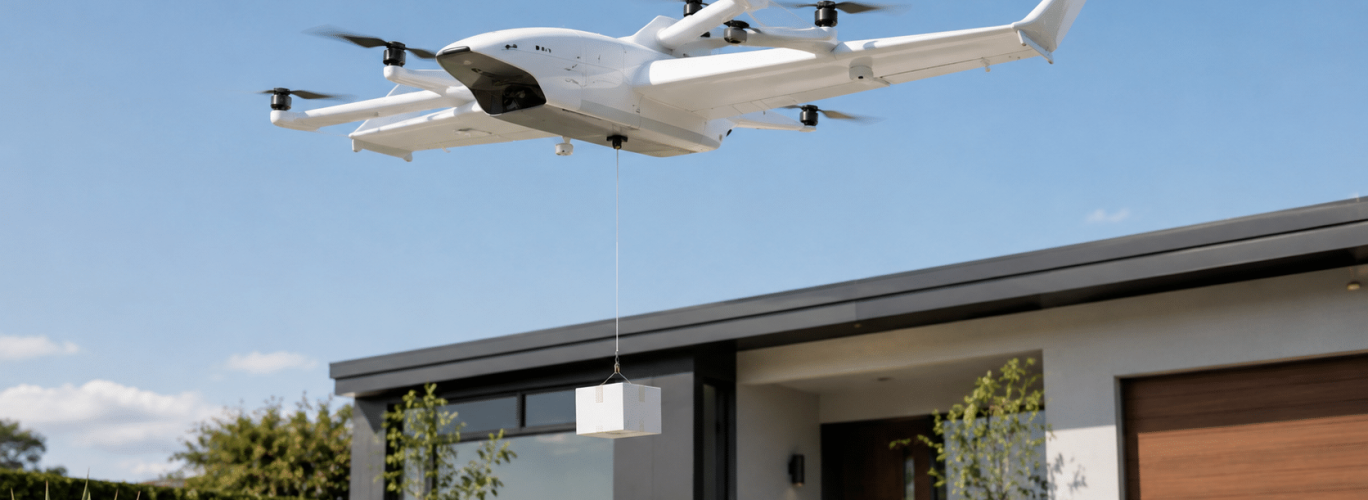
Autonomous delivery drones are quickly moving from an experimental idea to a practical part of modern logistics. As more companies explore autonomous delivery for packages and time-sensitive goods, these systems are bringing new engineering challenges into the air—and onto the ground.
Behind every flight is a tightly integrated network of electronics that must navigate, communicate, manage power, and operate reliably within strict limits on weight, space, and energy.
Autonomous delivery drones bring together propulsion, navigation, communications, sensing, power management, and package-handling electronics inside a compact, lightweight aircraft. Every one of these systems must perform reliably while exposed to vibration, changing temperatures, outdoor conditions, and constant pressure to conserve weight and battery power.
That creates a difficult engineering environment.
High-current motors and switching electronics can generate electromagnetic noise near sensitive navigation receivers. Multiple radios may operate close to processors, sensors, cameras, and antennas. Heat from power components and computing hardware must be moved away without adding excessive mass or reducing available payload space.
For drone designers, EMI shielding and thermal management are not separate finishing steps. They are closely connected design considerations that can affect flight stability, communication reliability, navigation accuracy, endurance, and long-term system performance.
The autonomous drone market is being shaped by companies applying advanced flight technology across a wide range of industries. Zipline and Wing are leading autonomous delivery for healthcare, retail and last-mile logistics, while Skydio focuses on infrastructure inspection, public safety and defense applications. DJI supports industrial inspection, mapping and automated commercial operations, and Anduril Industries is advancing autonomous systems for aerospace, defense, surveillance and reconnaissance. Together, these companies demonstrate how autonomous drones are expanding well beyond traditional aviation into critical commercial, industrial and defense applications.
Design Brief
Delivery drones place sensitive electronics close to motors, radios, batteries, and power-conversion hardware. The design must control conducted and radiated interference, move heat through limited spaces, maintain lightweight construction, and withstand vibration and outdoor exposure. Potential solutions include board-level shields, ferrites, enclosure gaskets, fingerstock, microwave absorbers, and thermal interface materials.

Inside a Drone Delivery Platform
A delivery drone may contain several interconnected electronic systems, including:
- Flight-control processors
- GNSS navigation receivers
- Inertial measurement units
- Telemetry, cellular, Wi-Fi, or other wireless radios
- Electronic speed controllers
- Brushless motors
- Battery-management electronics
- Cameras, radar, lidar, or proximity sensors
- Package-monitoring and release systems
- Ground-control and charging interfaces
These systems must share limited space inside the airframe. In many designs, noisy power electronics may be positioned only a short distance from low-level sensor circuits or sensitive RF receivers.
Lightweight airframes can make the challenge more difficult. Plastic and composite housings may provide less inherent shielding than a conductive metal enclosure. Openings for airflow, connectors, cameras, antennas, removable batteries, and maintenance access can also interrupt the electrical continuity needed for effective enclosure-level shielding.
The result is not one isolated EMI problem. It is a network of possible coupling paths across circuit boards, cables, seams, structural parts, and internal cavities.

Where Interference Begins
Several parts of a delivery drone can produce electromagnetic interference.
Motors and electronic speed controllers operate with rapidly changing currents. Switching regulators convert battery power for processors, sensors, radios, and payload systems. High-speed digital electronics generate harmonics that can couple into nearby conductors and assemblies. Wireless transmitters add intentional RF energy to an already crowded environment.
That unwanted energy can travel in several ways.
Conducted interference may move through power lines, grounding paths, cable shields, or signal conductors. Radiated interference can couple directly between nearby assemblies. Cables may carry noise from one area of the aircraft to another or radiate energy into sensitive electronics.

Problems may appear only during certain operating conditions, such as:
- Motor acceleration
- High-current climb or hover
- Radio transmission
- Payload activation
- Battery charging
- Package release
- Simultaneous sensor operation
This can make troubleshooting difficult. A drone may perform correctly on a bench but experience intermittent navigation, sensor, or communication problems under actual flight loads.
Systems Most Vulnerable to EMI
Navigation and Flight Control
GNSS receivers, magnetometers, inertial sensors, and flight-control processors depend on accurate, stable information. Noise entering these systems can reduce receiver sensitivity, distort sensor readings, or create inconsistent data.
Because these circuits may operate close to processors, radios, power electronics, and other potential interference sources, localized isolation can become an important part of the board design. Board-level shields can help reduce coupling into sensitive sections of the printed circuit board, while custom or multi-cavity configurations can separate several functional zones while conserving board space.
Wireless Communications
Delivery drones may rely on several communication links for telemetry, command, navigation corrections, payload data, or coordination with ground infrastructure.
These radio systems often operate near processors, power electronics, sensors, and other high-speed circuitry, creating multiple opportunities for unwanted coupling between transmitting, receiving, and digital sections. Conductive shielding can help reduce unwanted emissions or isolate sensitive RF circuitry, while microwave absorbers may help control RF energy reflecting inside enclosed or partially enclosed spaces when internal reflections become part of the problem.


Propulsion and Power Electronics
Motors, electronic speed controllers, DC-DC converters, and battery-management circuits are common sources of electrical noise. The related wiring can then become a path for that noise to reach other systems.
Ferrites can help suppress high-frequency noise on power, control, and signal conductors. The ferrite material, geometry, placement, and number of conductor passes should be matched to the actual frequency and current conditions rather than selected as a generic add-on.
Cameras and Payload Sensors
Cameras, radar, lidar, environmental sensors, and package-monitoring electronics may combine low-level signals with high-speed processing. These assemblies can be vulnerable to nearby noise while also generating emissions of their own.
Depending on where the interference originates and how it reaches the affected electronics, localized board-level shielding may help isolate sensitive circuitry, while enclosure continuity, cable-noise suppression, or targeted RF absorption may be appropriate elsewhere in the assembly.
Design Detail
Adding a shield can change airflow or retain heat near a component. Adding a heat spreader can change grounding, spacing, wireless performance, or enclosure fit. EMI shielding and thermal management should therefore be evaluated together in the assembled drone rather than treated as independent material decisions.
Managing Heat Without Sacrificing Flight Time
Drone electronics generate heat at nearly every level of the system.
Processors support autonomous navigation, obstacle detection, image processing, and flight calculations. Power electronics regulate battery energy and drive the motors. Radios transmit data. Battery-management systems monitor cell condition, charging, discharge, and temperature.
All of this occurs in an aircraft where adding weight can reduce flight time or payload capacity. Thermal management therefore has to move heat effectively without adding unnecessary mass, occupying excessive space, or creating mechanical requirements that conflict with the lightweight construction of the aircraft.
Thermal interface materials can improve heat transfer between components and adjacent heat spreaders, housings, frames, or other structural surfaces. Gap-filling materials can conform to uneven surfaces and compensate for mechanical tolerances that would otherwise leave insulating air gaps in the thermal path.
Material selection should consider more than thermal conductivity.
Engineers may also need to evaluate:
- Material thickness
- Compression requirements
- Electrical insulation
- Weight
- Surface conformity
- Vibration resistance
- Operating temperature
- Long-term stability
- Assembly and serviceability

In a drone, these considerations are closely connected to endurance and available space. A thermally effective material may still be a poor fit if it requires excessive compression, adds unnecessary thickness or weight, interferes with surrounding components, or does not remain stable under vibration and temperature cycling.
Closing Shielding Gaps in the Airframe
Even when a drone uses conductive structural parts or shielded electronic compartments, seams and openings can reduce overall shielding effectiveness.

Potential leakage locations include:
- Removable battery covers
- Payload access doors
- Connector openings
- Electronics compartment seams
- Camera and sensor openings
- Maintenance panels
- Charging interfaces
Fabric shielding gaskets and conductive foam can help maintain electrical continuity across lightweight covers and mating surfaces. These solutions may be useful where low compression force and conformability are important.
Fingerstock can provide resilient electrical contact along removable covers, doors, modules, or access points. It may be appropriate where repeated opening and closing require durable contact performance.
The correct solution depends on the mechanical design. Compression range, closure force, surface finish, environmental exposure, abrasion, vibration, and expected maintenance cycles should all be considered.


When Shielding Alone May Not Solve the Problem
Conductive shielding primarily redirects and contains electromagnetic energy. In some compact RF environments, however, the redirected energy may continue reflecting between internal surfaces.
These reflections can contribute to cavity resonance, coupling between nearby components, or changes in antenna and receiver performance.
Microwave absorbers may be used at targeted locations to reduce unwanted energy rather than reflect it elsewhere. Possible locations include areas near:
- Radio modules
- Antennas
- Radar electronics
- High-frequency processors
- Shield covers
- Reflective internal cavities
Absorber selection should be based on frequency range, thickness, placement, adhesive requirements, temperature, and environmental exposure. It is not a universal fix. The material must be matched to the electromagnetic behavior occurring in the design.
Thermally conductive absorbers may be considered where the same location must help control both heat and unwanted electromagnetic energy.
Matching the Solution to the Drone
| Location in the drone | Primary concern | Potential Leader Tech solution |
|---|---|---|
| Flight-control or navigation circuit board | Coupling into sensitive circuits | One-piece, two-piece, custom, or multi-cavity board-level shields |
| Radio and GNSS modules | Receiver interference and RF coupling | Board-level shields and microwave absorbers |
| Motor and power wiring | Conducted and radiated cable noise | Ferrites and cable-shielding components |
| Battery-management and power-conversion circuits | Switching noise and heat buildup | Board-level shielding, ferrites, and thermal interface materials |
| Electronics compartment seams | Loss of electrical continuity | Fabric shielding gaskets, conductive foam, or fingerstock |
| Processors and power devices | Heat trapped in compact housings | Thermal pads, gap fillers, and other thermal interface materials |
| RF cavities or reflective internal spaces | Resonance and internal RF reflections | Microwave absorbers |
| Custom brackets, covers, or shielding structures | Space, weight, and geometry constraints | Precision metal fabrication and custom shielding capabilities |
This table represents possible starting points, not universal prescriptions. The correct approach depends on the interference source, frequency, coupling path, mechanical design, thermal conditions, and operating environment.
Where Leader Tech Fits in the Design
The electronics inside a delivery drone can present several different EMI/RFI and thermal challenges, and the appropriate approach depends on where the problem originates, how it moves through the system, and which parts of the assembly are affected.
Where interference is concentrated around specific areas of a printed circuit board, Leader Tech board-level shielding options include standard, modified-standard, and custom shields, as well as one-piece, two-piece, and multi-cavity configurations. These designs can provide localized isolation while accommodating the available board space and component layout.
Other interference paths may require a different approach. Cable-borne noise associated with motors, converters, power lines, or control wiring can be addressed with appropriately selected ferrites. Where enclosure seams or removable sections need to maintain electrical continuity, fabric shielding gaskets, conductive foam, fingerstock, and other conductive-contact options may be considered according to the mechanical requirements of the assembly.

Internal RF behavior introduces another set of considerations. Microwave absorbers can be applicable when unwanted energy is reflecting within an enclosure or coupling between nearby high-frequency components. Similarly, thermal interface materials can help establish a more effective thermal path between processors, power devices, battery-management electronics, and surrounding structures when heat transfer becomes a limiting factor.
For applications where standard geometries do not match the available space or mechanical requirements, Leader Tech’s custom metal fabrication and prototype-to-production capabilities can support the development of shielding structures, brackets, covers, and related components.
These approaches are not interchangeable, and not every drone design will require each of them. The objective is not to add every possible material to the drone. It is to identify the source of the problem, understand how the energy or heat is traveling, and apply the most appropriate solution at the right location.
Frequently Asked Questions
What are the most common sources of EMI inside a delivery drone?
Common sources include motors, electronic speed controllers, switching power supplies, DC-DC converters, processors, transmitters, and high-current wiring. The exact source should be confirmed through testing because several systems may contribute simultaneously.
Which drone systems are most vulnerable to interference?
GNSS receivers, flight controllers, inertial sensors, communication modules, magnetometers, cameras, and payload sensors can all be vulnerable. Sensitivity depends on operating frequency, layout, cable routing, grounding, and distance from the interference source.
Can a board-level shield create a thermal problem?
It can. A shield may change airflow or retain heat around a processor or power component. The shielding structure, ventilation strategy, component temperature, and thermal path should be reviewed together.
When should a microwave absorber be considered?
An absorber may be useful when unwanted RF energy is reflecting within a cavity or coupling between nearby high-frequency components. Frequency, placement, available space, and environmental conditions must be understood before selecting the material.
How early should EMI and thermal solutions be evaluated?
They should be considered during circuit layout, cable routing, and enclosure development. Addressing interference or heat late in the project can require changes to board geometry, mechanical tooling, antennas, wiring, or structural components.
Reliable Flight Begins Inside the Aircraft
A delivery drone may be judged by how quickly and accurately it reaches its destination. That performance depends on an electronic system operating reliably inside a crowded and demanding environment.
Motors must run without disrupting navigation. Radios must communicate without overwhelming nearby receivers. Processors and power electronics must remain within acceptable temperatures. Enclosure joints must maintain electrical continuity despite vibration, weather, and repeated service.
Designing these systems successfully requires more than selecting a single shielding product or thermal material. It requires understanding how interference, heat, grounding, mechanical tolerances, weight, and environmental exposure interact throughout the aircraft.
By addressing those interactions early, engineers can build greater reliability into the drone before it reaches flight testing, compliance evaluation, and full-scale deployment.