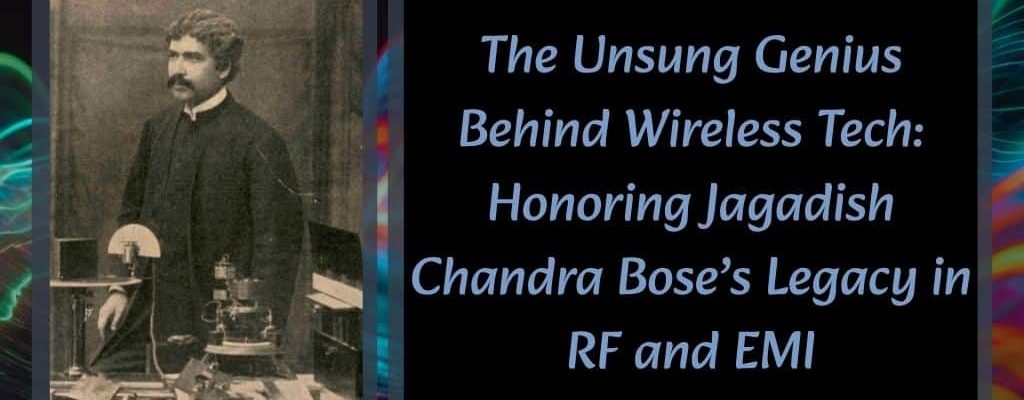
At the turn of the 20th century, while Western Europe was marveling at the works of Marconi and Hertz, an Indian physicist was quietly conducting some of the world’s earliest—and most ingenious—experiments in wireless transmission. Jagadish Chandra Bose, a man of extraordinary intellect and humility, stands as one of the uncredited pioneers of electromagnetic research.
Though often omitted from mainstream histories of wireless communication, Bose was not only one of the first to demonstrate radio wave propagation but also the inventor of a solid-state detector—decades before such devices would become standard in electronics.
A Multidisciplinary Genius Ahead of His Time
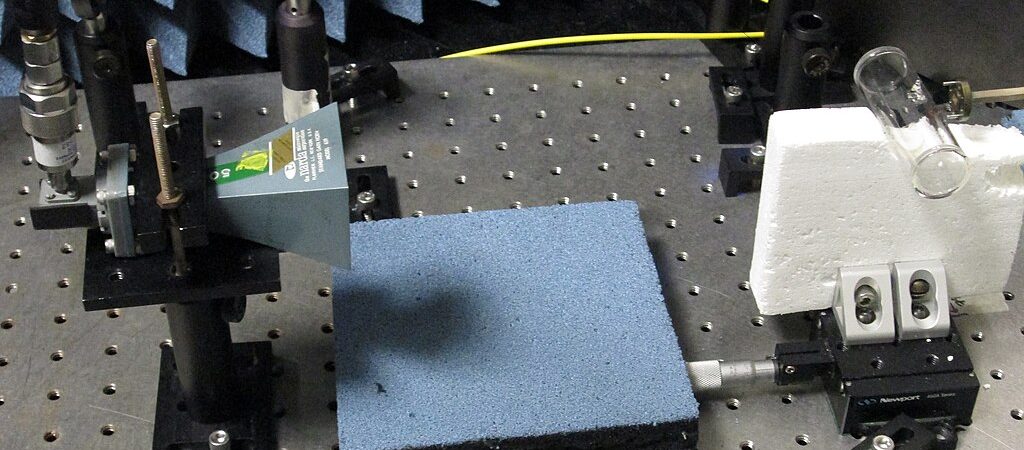
Born in 1858 in British-ruled India, Bose pursued studies in natural sciences at the University of Cambridge. But his contributions would soon transcend biology, physics, and engineering. While teaching at Presidency College in Calcutta, he began investigating the behavior of electromagnetic waves. Using millimeter waves (what we now call microwaves), Bose constructed a waveguide, horn antennas, and even a dielectric lens—entirely from locally sourced and improvised materials.
Bose’s work was pioneering not just in content but in method. At a time when radio signals were largely speculative, he demonstrated wireless signal transmission over 75 feet through walls, intervening barriers, and even human bodies. In 1895, this was a full year before Guglielmo Marconi’s much-lauded patent on wireless telegraphy. Yet Bose refused to commercialize his inventions, believing knowledge should be freely shared—an ideal that may have cost him widespread recognition during his lifetime.
The First Semiconductor Diode Detector
Perhaps Bose’s most remarkable contribution was the development of a solid-state detector—a metal/semiconductor junction that could rectify radio signals. In essence, he had created the first known example of what would later be recognized as a crystal diode. It was this little-known invention that foreshadowed the silicon revolution and the rise of semiconductors in global electronics.
His choice of galena (a natural semiconductor) as the detection medium, combined with a spring-loaded metal contact, essentially formed what we now call a point-contact diode. These principles were not seriously adopted by the scientific community until nearly 40 years later. Bose didn’t just anticipate modern electronics—he helped found it.
Recognition Denied—Then Rediscovered
While Bose received several honors later in life—including a knighthood and Fellow of the Royal Society—his contributions were largely overshadowed by those of his European contemporaries. Unlike Marconi, who vigorously patented and defended his technologies, Bose rarely applied for patents, and when he did, it was often reluctantly.
Only in recent decades have historians and engineers begun to restore Bose’s legacy, recognizing the depth and originality of his scientific achievements. From the theory of waveguides to pioneering detector technology, Bose’s work has become a foundation for many elements in today’s communication and defense industries.
From Bose’s Lab to Modern EMI and RF Management
The technologies Bose explored—microwave radiation, high-frequency transmission, and signal detection—are the same domains where today’s engineers face growing challenges. As devices become more compact and operate at higher frequencies, managing electromagnetic interference (EMI) and radio-frequency interference (RFI) has become mission-critical.
Leader Tech continues the legacy of innovation Bose began over a century ago. We offer a range of products specifically designed for high-frequency performance, including absorbing materials for microwave suppression, fabric-over-foam gaskets for seamless EMI shielding, and board-level shields that protect sensitive components from unwanted interference. For thermal regulation in tightly packed RF environments, our graphite thermal gaskets, thermally conductive absorbers, and thermal interface greases provide targeted heat mitigation without compromising electromagnetic control.
These technologies echo Bose’s early experiments—translating foundational discoveries into modern engineering solutions that help safeguard today’s wireless and defense electronics.
Conclusion: A Legacy Written in Waves
Jagadish Chandra Bose’s life reminds us that great innovation doesn’t always come with great recognition. Yet his discoveries ripple through the modern world—resonating in every Wi-Fi signal, every radar system, and every shielded enclosure. By anticipating the behavior of electromagnetic waves and developing the tools to control them, Bose became a quiet architect of our wireless age.
His story is not just one of scientific brilliance but of a vision undeterred by fame or fortune. And as we continue to shape the future of high-frequency technology and signal integrity, we build on the waves Bose first set in motion.