

The future of advanced technology is being built at the crossroad of innovation and precision — and nowhere is that intersection more critical than in American manufacturing. As groundbreaking fields like augmented reality (AR/VR), electric vehicles (EVs), and quantum accelerated supercomputing, the conversation is no longer about producing more — it’s about producing with engineering integrity. Devices that operate at high frequencies, depend on ultra-clean signals, and require millimeter-perfect construction cannot rely on mass production alone. They demand manufacturers capable of mastering materials, shielding, and thermal control at a level only specialized American companies can deliver.
Leader Tech stands within that space — not as a backdrop, but as an active contributor to the technical backbone enabling next-generation technologies to function reliably in the real world.
Beyond Production: Why the Future Demands Precision Manufacturing
The technologies shaping the coming decade are fundamentally different from those of the past. They are more compact, more powerful, and more sensitive to their environments. AR headsets push immersive computing through micro-displays and high-bandwidth sensors. EV platforms carry dense electronics in thermally stressed enclosures. Quantum devices rely on immaculate electromagnetic stability to maintain coherence.
These are not platforms that tolerate interference, signal loss, or heat drift. They require components crafted with an understanding of electromagnetic behavior, thermal dynamics, and mechanical integrity. In this emerging era, manufacturing is no longer just about fabrication — it is about engineering stewardship.

AR/VR and the Challenge of Signal Purity in Immersive Devices
Augmented and virtual reality headsets are evolving into wearable supercomputers. Eye-tracking cameras, LiDAR depth mapping, wireless connectivity, and micro-LED displays are packed into ultra-thin form factors. Inside these headsets, dozens of sensors operate simultaneously, producing a dense electromagnetic environment.
- EMI/RFI interference can distort imaging and tracking data.
- High-frequency wireless signals demand stable ground paths to maintain clarity.
- Internal heat, if unmanaged, affects user comfort and sensor calibration.
As these systems evolve toward all-day wearable computing, the margin for internal noise or overheating drops to near-zero. It is within this constraint that American manufacturing proves its value — not through volume, but through precision, repeatability, and material expertise.

EVs: Power, Heat, and the Electronics Within the Machine
Electric vehicles are often seen through the lens of batteries and motors, but their true complexity lies in the electronics that govern them. Onboard chargers, inverters, smart sensors, driver assistance modules — each generates high-frequency switching and is vulnerable to EMI/RFI disturbance.
Inside an EV platform:
- Power electronics emit electromagnetic noise that can disrupt control systems.
- Thermal fluctuations affect both performance and battery lifespan.
- Reliability expectations exceed consumer electronics by several orders of magnitude.
This is where high-performance shielding and thermal interface materials come into play. Future EV systems will depend increasingly on compact component integration, demanding materials that can both isolate interference and move heat without mechanical failure. These are engineering challenges, not production quotas.

Quantum Devices: Manufacturing at the Edge of Physics
Quantum computing symbolizes the highest form of next-generation precision — operating in environments where a single photon or magnetic fluctuation can change results. Within cryogenic chambers, electromagnetic purity is non-negotiable. Vibrations, thermal drift, and interference at even the faintest levels can disrupt qubit stability.
There is no “good enough” in quantum production. The enclosures, contact points, and shielding materials used in these systems must be crafted and handled with zero tolerance for contamination or EMI/RFI leakage. This represents one of the purest expressions of why advanced technologies require advanced manufacturing — and why American expertise is irreplaceable in such domains.
Leader Tech’s Role in Building America’s High-Tech Future
As emerging technologies move deeper into the realms of ultra-high frequencies, real-time computation, and thermal density, Leader Tech’s product portfolio becomes more than a catalog — it becomes a toolkit for engineering stability. Each product category serves a specific technical purpose, crafted to defend performance where conventional materials fail.
EMI/RFI Shielding Solutions

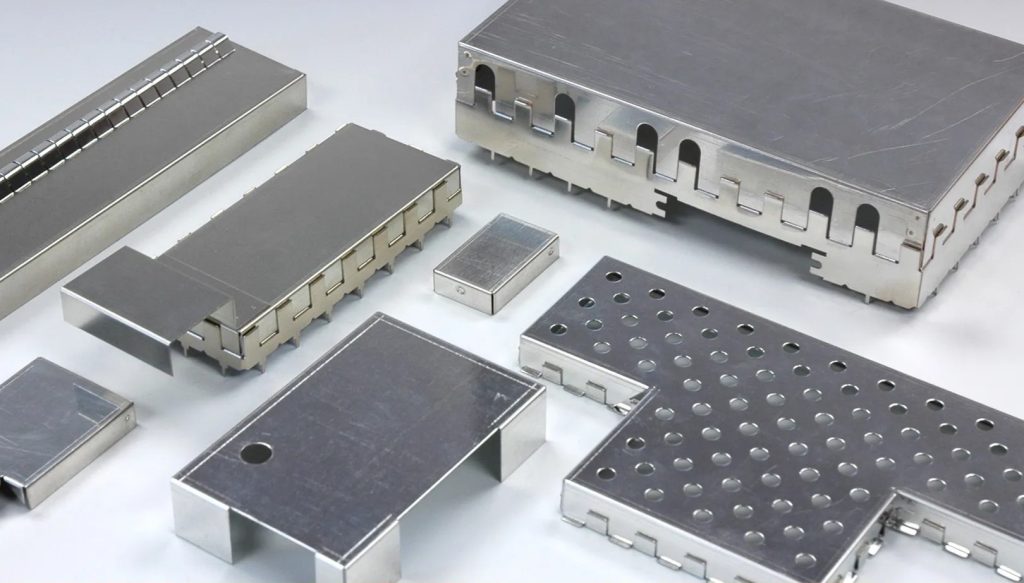
Leader Tech’s board-level shields are manufactured in one-piece and two-piece configurations to serve different engineering requirements.
- One-piece shields offer continuous protection for mass production where access isn’t required.
- Two-piece shields with removable lids support prototyping and rework in AR/VR optical engines, EV control modules, and RF-based sensor hubs.
These shields prevent crosstalk between high-speed processors, image processing units, and wireless transceivers — vital for AR headsets and vehicle radar/LiDAR systems where signal contamination directly affects performance.

Fabric-Over-Foam Gaskets (FSG)
Fabric-over-foam gaskets provide a compressible shielding interface for housing seams and panel joints. They combine conductive fabric with a polyurethane foam core to maintain constant contact pressure.
- Used in AR/VR enclosures, they preserve signal clarity by closing micro-gaps around sensor housings.
- In EV electronics, they prevent EMI/RFI leakage in telematics and drive-control units while accommodating vibrations and thermal expansion.

Designed for harsh environments, Leader Tech’s conductive elastomers are formulated using silicone or fluorosilicone bases, filled with materials such as nickel-graphite or silver-aluminum.
- Silicone-based elastomers offer general EMI shielding with flexibility.
- Fluorosilicone variants resist fuel, oil, and chemical exposure — critical in EV battery enclosures and power inverters.
These elastomers create combined environmental and electromagnetic seals, protecting sensitive circuitry against both interference and contamination.
Thermal Interface & Absorptive Materials
Leader Tech’s thermal product line brings together advanced materials designed to manage heat in the world’s most demanding electronic systems. From immersive AR/VR headsets to EV power modules and quantum processors, our solutions deliver consistent performance, stability, and protection under variable thermal loads.
This product family includes graphene-based interfaces known for their exceptional in-plane conductivity, indium layers for precise contact in cryogenic or ultra-low-resistance environments, and other engineered thermal compounds developed for reliable heat transfer and EMI/RFI stability.
Each material is formulated to balance conductivity, mechanical durability, and integration flexibility, enabling seamless use in both compact and high-power assemblies. Together, these innovations define Leader Tech’s commitment to American-made thermal technology — ensuring that future devices stay cool, efficient, and ready for performance at every level.


Precision Metal Fabrication & Engineered Hardware
Leader Tech provides custom-fabricated contacts, shields, spring fingers, and brackets produced from brass, copper, steel, and nickel alloys. These components establish electrical grounding, mechanical retention, and signal referencing in compact device assemblies.
- AR/VR Systems: Custom-formed internal brackets align optics and PCB modules while maintaining shielding continuity.
- EV Systems: Formed ground springs maintain chassis connection across modular electronics under vibration and shifting loads.

Modified Standards & Value-Added Services
Engineers often begin with standard components, but production realities require modifications. Leader Tech supports customizations such as:
- Vent perforations for airflow
- Tool-free lids and inspection ports
- Integration of pressure-sensitive adhesives for automated assembly lines
These manufacturing capabilities allow integration into high-volume American production without forcing compromise on performance or tolerances.
A Commitment to American Craftsmanship
Leader Tech’s contribution to American manufacturing lies not in scale, but in precision. We engineer the unseen elements that allow next-generation hardware to survive heat, silence noise, and maintain stability through every stage of operation. As AR/VR becomes wearable reality, EVs redefine mobility, and quantum unlocks new physics; Leader Tech continues to provide the material certainty that future technologies demand.
Why American Manufacturing Still Matters
In a world chasing digital speed, hardware remains deeply physical. Circuits must be shielded. Heat must be dispersed. Signals must be clean. No amount of software can compensate for electromagnetic chaos or thermal instability.
American manufacturing, at its finest, is not defined by volume — but by mastery. By an ability to understand how metals behave under frequency stress, how composites react under thermal load, and how microscopic seams become conduits for interference.
This is the arena where Leader Tech operates. Not as a supplier behind the scenes, but as part of the engineering foundation upon which future AR lenses, EV power modules, and quantum processors will rely.

Conclusion: Building Tomorrow, One Layer at a Time
The devices shaping tomorrow are not imagined — they are built. Layer by layer. Shield by shield. Gasket by gasket. As AR redefines perception, EVs reshape mobility, and quantum computing rewrites the limits of logic, they will all depend on the unseen, engineered layers that make performance possible.
In that future, American manufacturing will not compete on cost — it will lead through precision. And within that tradition, Leader Tech will continue to serve as one of the silent architects of reliability, crafting the components that make the impossible stable, and the invisible work.
Because the future is not only coded. It is manufactured.