USA-Made

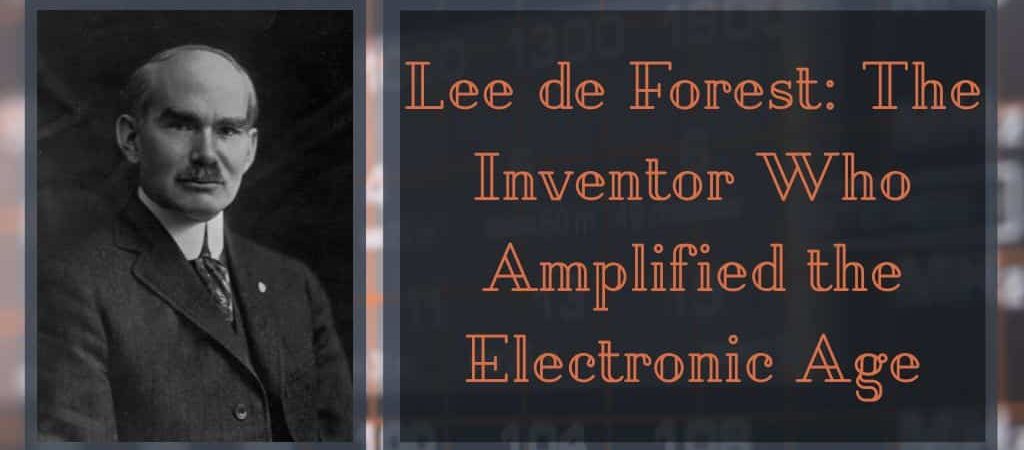
Lee de Forest: The Inventor Who Amplified the Electronic Age

DeForest COVER

Before the transistor, before integrated circuits, and before modern semiconductor devices, electronic technology depended on one invention that made amplification practical. In 1906, Lee de Forest introduced the Audion vacuum tube, adding a control grid to the existing diode design and creating the world’s first practical electronic amplifier. That single innovation transformed radio from an experimental curiosity into a technology capable of broadcasting voices and music across continents, while also paving the way for television, long-distance telephony, radar, and the earliest electronic computers. Although later overshadowed by the transistor, De Forest’s work marked one of the most significant turning points in the history of electronics.

Lee de Forest: The Inventor Who Amplified the Electronic Age

Born on August 26, 1873, in Council Bluffs, Iowa, Lee de Forest grew up during a period when electricity was beginning to reshape society. His father, a Congregational minister, hoped his son would pursue a religious career, but De Forest developed an early fascination with science and engineering.

He attended Yale University’s Sheffield Scientific School, where he earned a doctorate in physics in 1899. His research focused on electromagnetic waves, placing him at the forefront of a rapidly evolving field inspired by the discoveries of Heinrich Hertz and the wireless communication experiments of Guglielmo Marconi. At the turn of the twentieth century, wireless telegraphy was still in its infancy, and De Forest became determined to improve the technology.

Lee DeForest
Audion Tube

Improving Wireless Communication

Early radio systems relied on spark-gap transmitters and simple detectors that could receive Morse code but struggled with weak signals. As engineers sought ways to increase transmission distances and improve reception, De Forest believed the answer lay in better electronic detection and amplification.

He founded several companies devoted to wireless communication, designing transmitters, receivers, and detection devices. While many of these ventures struggled financially, they provided valuable opportunities to experiment with electronic circuits and vacuum technology.

Those experiments culminated in the invention that would define his career.

The Audion Changes Everything

In 1906, De Forest patented the Audion, a vacuum tube based on John Ambrose Fleming’s earlier diode. Fleming’s device contained two electrodes and could detect radio signals, but it offered no meaningful amplification.

De Forest added a third electrode, known as the control grid, between the filament and the plate. This seemingly modest modification allowed a small electrical signal applied to the grid to control a much larger current flowing through the tube.

For the first time, weak electrical signals could be amplified reliably.

The implications were enormous. Engineers could now design receivers capable of detecting distant broadcasts, telephone systems that carried conversations over far greater distances, and electronic circuits that processed signals with unprecedented efficiency.

Although later refinements by other engineers greatly improved the Audion’s performance, De Forest’s three-electrode design established the basic principle of electronic amplification.
Audion AM radio transmitters
Lee de Forest's Audion transmitters helped transform wireless communication by introducing practical electronic amplification, enabling stronger and more reliable radio broadcasts.
Audion detector
The RJ9 Audion detector illustrates how vacuum tube technology dramatically improved the reception of weak radio signals, laying the foundation for modern electronic amplification.

Building the Age of Electronics

The Audion quickly became one of the most important components in twentieth-century electronics.

Vacuum tube amplifiers made commercial radio broadcasting practical, allowing stations to reach millions of listeners with clear audio. Telephone networks expanded dramatically as amplified signals traveled farther without excessive loss. During the following decades, vacuum tubes also enabled television broadcasting, radar systems, public address equipment, medical electronics, and military communications.

Perhaps most significantly, nearly every electronic computer built before the arrival of the transistor depended on vacuum tubes derived from De Forest’s invention. Machines such as ENIAC used thousands of vacuum tubes to perform calculations that had previously required human operators.

While today’s integrated circuits contain billions of transistors, the concept of controlling electrical signals through active electronic devices can be traced directly to the Audion.

Lee DeForest

Bringing Sound to Motion Pictures

De Forest’s influence extended beyond radio.

During the early 1920s, the film industry sought practical methods of synchronizing sound with moving images. Rather than relying on separate phonograph recordings, De Forest developed Phonofilm, a system that recorded sound optically as variations directly on the film strip.

Although competing technologies ultimately became the industry standard, Phonofilm demonstrated that synchronized sound films were commercially possible. It represented another example of De Forest applying electronic innovation to solve a major technological challenge.

His work helped bridge the gap between silent cinema and the era of talking pictures.

Challenges and Controversies

Despite his technical achievements, De Forest’s career was rarely straightforward.

He became involved in numerous patent disputes with competitors, manufacturers, and large corporations, including lengthy legal battles over the rights to vacuum tube technology. Financial difficulties followed him throughout much of his life, and many of the companies he founded failed to achieve lasting success.

Interestingly, historians have noted that De Forest himself did not fully understand the physics behind why the Audion amplified signals so effectively. Later researchers developed a deeper understanding of electron behavior inside vacuum tubes, enabling more reliable and efficient designs.

Even so, invention often precedes complete scientific understanding, and De Forest’s practical insight proved transformative.

Lee DeForest sending telephone message
Lee de Forest demonstrates one of his early wireless communication systems at the 1904 World's Fair, reflecting his efforts to advance radio technology before the invention of the Audion.

A Lasting Legacy

The invention of the transistor at Bell Labs in 1947 gradually replaced vacuum tubes in most electronic equipment, ushering in the semiconductor age. Yet the transition to transistors does not diminish De Forest’s importance. His Audion established the first practical method of electronic signal amplification, making modern electronics possible decades before semiconductor devices emerged.

Today, every amplifier, radio receiver, communication system, and computing device owes something to the breakthrough achieved in 1906. From wireless broadcasting to digital communications, the ability to control and strengthen electrical signals remains one of the defining principles of electronic engineering.

At Leader Tech, we recognize that every generation of electronics builds upon the innovations that came before it. While today’s designs rely on advanced EMI/RFI shielding, thermal management, and high-speed electronic systems, they all trace their origins to pioneers like Lee de Forest, whose work transformed electricity from a means of transmitting signals into the foundation of the electronic age.

Audion Amp Colorized
An early vacuum tube amplifier demonstrates how the Audion's ability to amplify electrical signals became the basis for countless electronic circuits.
Vacuum tube Radio Receiver 50s
Vacuum tube radios, such as this mid-twentieth-century receiver, represent the widespread adoption of amplification technology pioneered by Lee de Forest's Audion.
LinkedIn
X
Facebook
Email
David Mendez Galpern
Leader Tech EMI/RFI Shielding integrated into aerospace applications

Subscribe to receive our newsletters and product updates

This field is for validation purposes and should be left unchanged.
Leader Tech Inc needs the email address you provided to send you our newsletters and product updates. You may unsubscribe from these communications at any time.
Archives
×

Rep Firm

Office Closure.

In observance of the Labor Day holiday, our office will be closed on Monday, September 7th.

We will resume normal business hours on Tuesday, September 8th at 8 am EST.

We will get back to your inquiries as soon as possible.