

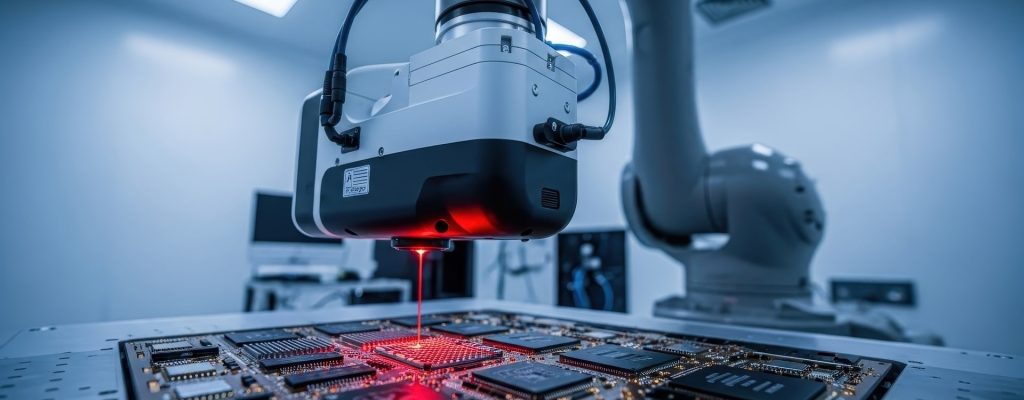
Electronic assemblies continue to become more compact, interconnected, and capable. Built upon semiconductor technology, today’s designs integrate greater processing power, faster communications, more sophisticated sensing capabilities, and increasingly complex control functions than ever before.
Whether the application involves control electronics, sensor modules, communications hardware, motion-control systems, or densely populated PCB assemblies, one challenge remains consistent: managing electromagnetic interference and radio frequency interference (EMI/RFI). As electronic density increases and more functions are integrated into a single assembly, maintaining signal integrity, measurement accuracy, communications reliability, and electromagnetic compatibility becomes increasingly important.
PCB Assemblies and Signal Integrity
PCB assemblies often serve as the foundation for modern electronic designs, integrating processors, memory devices, communications interfaces, sensor circuitry, and power management components onto a single board. As operating frequencies increase and layouts become more compact, maintaining signal integrity becomes increasingly challenging.
In many applications, a single PCB may be responsible for processing sensor inputs, controlling motion systems, managing communications, and coordinating power distribution simultaneously. This concentration of functionality increases the potential for unwanted electromagnetic coupling between neighboring circuits.

Signals generated in one portion of an assembly can affect nearby circuitry, creating noise, timing issues, or communication errors that may not be immediately obvious during development. For this reason, EMI/RFI mitigation is often considered early in the PCB design process rather than after performance issues appear. Understanding how electromagnetic energy moves across a board and between adjacent circuits is critical to maintaining reliable operation.
Control Electronics and System Reliability
Control electronics are responsible for coordinating system functions, processing inputs, and managing outputs. In practice, these assemblies may control positioning stages, coordinate robotic handling systems, manage process parameters, or synchronize multiple subsystems operating simultaneously.
Because control electronics frequently interact with sensors, communications hardware, and power electronics, they often sit at the center of multiple EMI/RFI pathways. Noise introduced into control circuitry can affect system behavior in ways that are difficult to diagnose, particularly when multiple electronic assemblies operate within close proximity.
Maintaining isolation between sensitive circuitry and potential emission sources helps support reliable and predictable operation. As electronic assemblies become increasingly integrated, designers must pay close attention to how emissions generated by one circuit may influence another.

Sensor Modules and Measurement Accuracy
Sensor modules often rely on low-level signals to provide position, temperature, pressure, optical, current, or other operational data. For example, optical sensors may verify alignment during inspection processes, temperature sensors may monitor critical electronics, and position sensors may provide feedback for precision motion-control assemblies.
Interference affecting sensor circuits may reduce measurement accuracy, introduce instability into control loops, or degrade overall system performance. The challenge becomes greater when sensor assemblies are located near communications hardware, power electronics, or motion-control components.
Protecting these signal paths requires consideration of both electrical design practices and the physical arrangement of surrounding assemblies. When accurate measurements are essential to overall system performance, even relatively small amounts of electromagnetic noise can become problematic.

Motion-Control Systems and Electrical Noise
Motion-control systems present their own EMI/RFI challenges. Motors, servo drives, controllers, and associated power electronics can generate electrical noise that propagates through cables, PCB assemblies, and enclosure structures.
These systems are often used to position inspection cameras, move robotic handling equipment, control automated stages, or maintain precise alignment within high-accuracy assemblies. Because motion-control hardware frequently operates near control electronics and sensor modules, emissions generated during operation can affect nearby circuitry if not properly managed.
The issue is not simply the presence of emissions, but how those emissions interact with neighboring subsystems. As designs become more compact, understanding these interactions becomes an increasingly important part of electromagnetic compatibility planning.

Communications Hardware and Data Integrity
Communications hardware enables the exchange of commands, sensor data, diagnostics, and operational information between electronic assemblies. A control board may communicate with a motor controller, sensor module, human-machine interface, or remote monitoring system thousands of times per second.
As data rates continue to rise, communication channels become more sensitive to disruptions caused by EMI/RFI. Noise introduced through nearby circuits, power electronics, or poorly controlled interface points can affect data integrity, leading to communication errors and reduced system reliability.
Maintaining reliable communications requires attention not only to electronic design but also to the physical pathways through which electromagnetic energy can travel. Designers must evaluate both emission sources and potential coupling paths throughout an assembly.
Where EMI/RFI Enters the Design
EMI/RFI challenges are often associated with electronic components, but many problems originate at physical interfaces.
Enclosure seams, removable covers, access panels, service doors, and cable entry points can all become pathways through which electromagnetic energy enters or escapes an assembly. Even when conductive materials are used throughout an enclosure, gaps between mating surfaces can reduce shielding effectiveness if electrical continuity is not maintained.
For enclosure designers, these interfaces often represent the most critical points in the design. A well-designed PCB assembly can still experience EMI/RFI problems if enclosure interfaces allow electromagnetic energy to bypass shielding measures.
Accessibility, serviceability, environmental sealing, and shielding effectiveness must all be balanced simultaneously. Understanding where electromagnetic energy enters, exits, or propagates through a design is often one of the most important steps in developing an effective mitigation strategy.

How Leader Tech Products Support EMI/RFI Mitigation
Because EMI/RFI can originate and propagate through multiple pathways, mitigation efforts are often most effective when applied at the locations where those pathways occur.
Within PCB assemblies, sensitive circuits may require localized shielding to reduce coupling from nearby emission sources. Board Level Shields can help isolate critical areas within densely populated electronic designs where maintaining signal integrity is a priority.
At enclosure seams, removable covers, access panels, and other mating surfaces, maintaining electrical continuity is essential to preserving shielding effectiveness. Conductive Elastomers and Fabric-Over-Foam Gaskets can help address these interface points while accommodating manufacturing tolerances and repeated access requirements.

Service doors, removable modules, and maintenance access points create additional challenges because conductive contact must remain reliable throughout repeated operating cycles. Beryllium Copper Fingerstock can help maintain electrical continuity between mating surfaces while supporting long-term shielding performance.
Applications with specialized enclosure geometries or unique interface requirements may also benefit from custom metal fabrication capabilities that support application-specific shielding structures and conductive features.
By addressing PCB-level, enclosure-level, and interface-level pathways, designers can develop more comprehensive EMI/RFI mitigation strategies that support overall system performance.
Designing for Electromagnetic Compatibility
EMI/RFI challenges rarely originate from a single source. More often, they emerge through the interaction of PCB assemblies, control electronics, sensor modules, communications hardware, motion-control systems, and enclosure interfaces operating within the same design.
As electronic assemblies continue to become more powerful and compact, electromagnetic compatibility must be considered alongside mechanical, thermal, and functional requirements. Identifying potential interference paths early in development allows designers to address issues before they affect performance, reliability, or serviceability.
By understanding how electromagnetic energy moves throughout a design—and where it enters, exits, or couples between assemblies—engineers can develop more effective strategies for maintaining signal integrity, measurement accuracy, communications reliability, and long-term system performance.