USA-Made

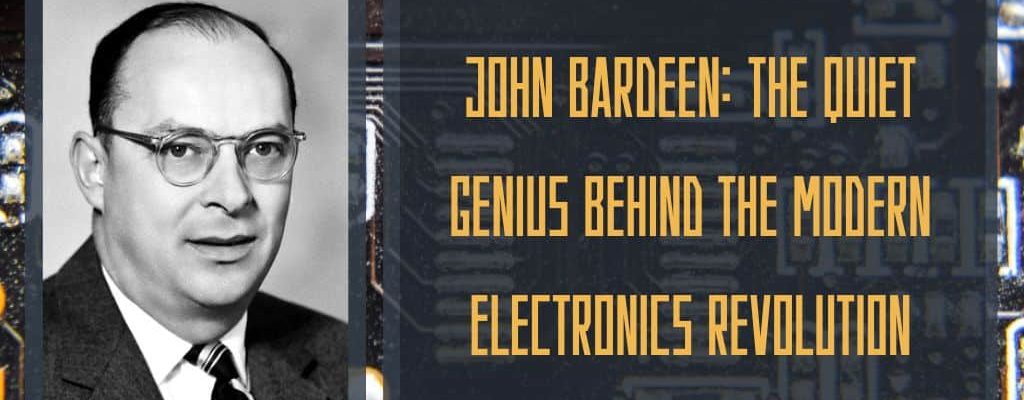
John Bardeen: The Quiet Genius Behind the Modern Electronics Revolution

BARDEENcover

Some innovators become household names. Their inventions are visible, dramatic, and easy to recognize. Others leave their mark in ways most people never see. Their work becomes so deeply embedded in everyday life that it fades into the background.

John Bardeen belongs firmly in the second category.

While names like Tesla, Edison, and Marconi are widely known, Bardeen remains unfamiliar to many outside scientific and engineering circles. Yet few individuals have had a greater impact on modern technology. He helped invent the transistor, the tiny device that made modern electronics possible, and later helped explain one of physics’ greatest mysteries: superconductivity.

His achievements earned him a distinction no one else has matched—he remains the only person to receive the Nobel Prize in Physics twice.

Today, nearly every electronic device owes something to his work. Smartphones, computers, satellites, medical equipment, communication systems, and countless other technologies all trace part of their lineage back to John Bardeen.
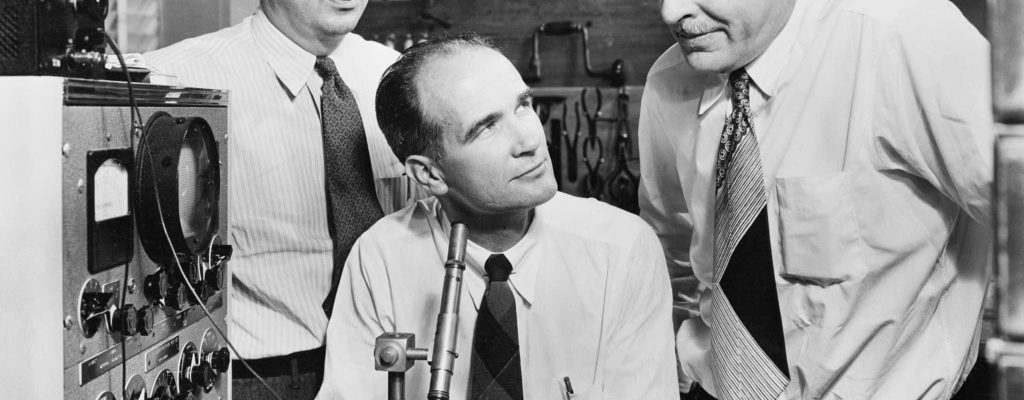
Bardeen_Shockley_Brattain_1948
John Bardeen (left), William Shockley (center), and Walter Brattain (right) pose shortly after their groundbreaking work on the transistor at Bell Laboratories. Their achievement would become one of the most influential technological breakthroughs of the twentieth century.

A Mind Built for Engineering

John Bardeen was born in Madison, Wisconsin, in 1908. From an early age, he displayed a natural talent for mathematics and science. Unlike many famous inventors, however, he was not known for grand experiments or dramatic demonstrations. Instead, he developed a reputation for careful thinking and an ability to solve difficult problems.

He studied electrical engineering at the University of Wisconsin before continuing his education in physics. This combination of disciplines would later become one of his greatest strengths. He understood both the practical challenges engineers faced and the deeper scientific principles behind them.

That balance helped prepare him for one of the most important technological challenges of the twentieth century.

Vacuum Tube
Before the invention of the transistor, vacuum tubes were the primary building blocks of electronic systems. While revolutionary for their time, they were large, fragile, and power-hungry compared to the solid-state devices that would eventually replace them.
Transistor
The transistor helped transform electronics by providing a smaller, more reliable, and energy-efficient alternative to vacuum tubes. Modern electronic devices often contain millions or even billions of transistors working together on a single chip.

Bell Labs and the Search for a Better Device

By the 1940s, electronics relied heavily on vacuum tubes. These components made radio, radar, and early computers possible, but they had serious drawbacks. They were bulky, fragile, generated significant heat, and consumed large amounts of power.

Researchers knew a better solution had to exist.

At Bell Laboratories, one of the world’s leading research centers, Bardeen joined a team investigating semiconductors. Working alongside Walter Brattain and William Shockley, he sought a way to control electrical current using solid materials rather than vacuum tubes.

Bell Labs
Bell Telephone Laboratories in Murray Hill, New Jersey

The challenge proved difficult. Semiconductor behavior was not fully understood, and many experiments produced confusing results. Bardeen’s ability to analyze complex physical phenomena became critical. He helped explain how electrons behaved near the surface of semiconductor materials, allowing the team to overcome obstacles that had frustrated researchers for years.

Their efforts would soon lead to a breakthrough that changed the world.

The Small Device That Changed Everything

In December 1947, Bardeen and Brattain successfully demonstrated the first working transistor.

The device was small, but its significance was enormous.

A transistor could act as both a switch and an amplifier, performing many of the same functions as a vacuum tube while being smaller, more reliable, and far more energy efficient. What began as a laboratory achievement quickly became the foundation of modern electronics.

As transistors improved, engineers could build smaller and more powerful devices. Computers that once filled rooms eventually fit on desks. Later, integrated circuits allowed thousands, then millions, and eventually billions of transistors to be placed on a single chip.

The result was the digital revolution.

Every smartphone, laptop, communication network, and embedded electronic system depends on transistors. The modern world is built upon their ability to control electrical signals with extraordinary precision.

Bardeen’s contribution was not simply the creation of a better component. He helped create the foundation upon which modern electronics would be built.

Smartphone

Recognition Without Spectacle

The invention of the transistor earned Bardeen, Brattain, and Shockley the Nobel Prize in Physics in 1956.

For many scientists, such an achievement would define an entire career. For Bardeen, it became only one chapter.

Despite his success, he remained remarkably humble. Colleagues often described him as thoughtful, approachable, and collaborative. He rarely sought attention and preferred focusing on research rather than publicity.

This quiet demeanor set him apart from many of the larger-than-life figures often associated with technological breakthroughs.

Bardeen demonstrated that world-changing innovation does not always come from the loudest voice in the room. Sometimes it comes from patience, persistence, and a willingness to understand problems at their deepest level.

John Bardeen and Colleagues
John Bardeen, the only individual to receive the Nobel Prize in Physics twice, is recognized for his extraordinary contributions to both transistor technology and the theory of superconductivity.

A Second Breakthrough: Superconductivity

After leaving Bell Labs, Bardeen joined the University of Illinois, where he continued pursuing difficult scientific questions.

One of the most intriguing was superconductivity.

Scientists had known since 1911 that certain materials could conduct electricity without resistance at extremely low temperatures. However, nobody fully understood why this phenomenon occurred.

Working with Leon Cooper and Robert Schrieffer, Bardeen developed what became known as BCS Theory. Their work explained how electrons could pair together under certain conditions and move through a material without encountering the resistance found in ordinary conductors.

Superconductivity Plaque
A commemorative plaque at the University of Illinois honors the development of BCS Theory.

The theory transformed the scientific understanding of superconductivity and remains one of the most important achievements in modern physics.

In 1972, Bardeen, Cooper, and Schrieffer received the Nobel Prize in Physics for their work.

With that award, Bardeen achieved something unique in scientific history: a second Nobel Prize in Physics.

From Transistor Density to EMI/RFI Challenges

The transistor revolution did more than make electronics smaller. It allowed engineers to place increasingly complex functionality into compact spaces.

As devices became more powerful, however, new challenges emerged.

Higher operating speeds, increased component density, and more sophisticated communication systems created opportunities for unwanted electromagnetic interference. Thermal management also became increasingly important as electronic systems generated more heat within smaller enclosures.

Modern engineers must carefully manage these issues to ensure reliability and performance.

Transistor Structures
Modern electronic systems rely on densely packed transistor structures to amplify, process, and control electrical signals. Advances in semiconductor technology have enabled the remarkable performance and miniaturization seen in today's devices.
products

This is where many of Leader Tech’s products support today’s electronic designs. Board-Level Shields can help contain emissions and reduce interference at the source. Conductive Elastomers and Fabric-Over-Foam Gaskets can help maintain shielding effectiveness across enclosure seams and openings. Ferrite-based products can suppress unwanted high-frequency noise, while Thermal Interface Materials help transfer heat away from critical components.

The need for these technologies is closely tied to the success of the transistor itself. As electronic systems became faster, denser, and more capable, controlling EMI/RFI and heat became increasingly important.

In many ways, the engineering challenges of today are a direct result of the possibilities Bardeen helped create.

The Quiet Genius Endures

John Bardeen passed away in 1991, but his influence continues to grow. The world has become increasingly dependent on electronics, communications, and computing technologies built upon the principles he helped establish.

Unlike some innovators whose fame rivals their accomplishments, Bardeen’s reputation remains relatively modest compared to the scale of his impact. Yet his work stands among the most significant technological achievements of the modern era.

His story also offers an important reminder. Innovation is not always driven by publicity or personality. Sometimes it comes from careful thinking, collaboration, and a commitment to understanding how the world works.

Bardeen exemplified those qualities throughout his career.

LinkedIn
X
Facebook
Email
David Mendez Galpern
Leader Tech EMI/RFI Shielding integrated into aerospace applications

Subscribe to receive our newsletters and product updates

This field is for validation purposes and should be left unchanged.
Leader Tech Inc needs the email address you provided to send you our newsletters and product updates. You may unsubscribe from these communications at any time.
Archives
×

Rep Firm