

When commercial electronics move from the factory floor to the field, a transformation begins—one not always accounted for in the lab. While devices may pass a range of qualification tests in controlled environments, real-world conditions introduce a different level of complexity: fluctuating temperatures, unpredictable interference sources, moisture, vibration, and more.
The environments in which modern electronics operate are rarely static or forgiving. Whether it’s a factory with heavy motor-driven equipment, a medical facility dense with wireless signals, or a communications unit mounted on an outdoor pole, each deployment introduces unique variables. These variables can intensify stress on shielding, grounding, and thermal management systems in ways that lab conditions simply can’t replicate.
These factors can reveal design vulnerabilities that standardized testing often fails to anticipate. At Leader Tech, we understand that delivering lasting performance requires more than regulatory compliance—it demands solutions engineered with real-world deployment in mind.
The Disconnect Between Design and Deployment
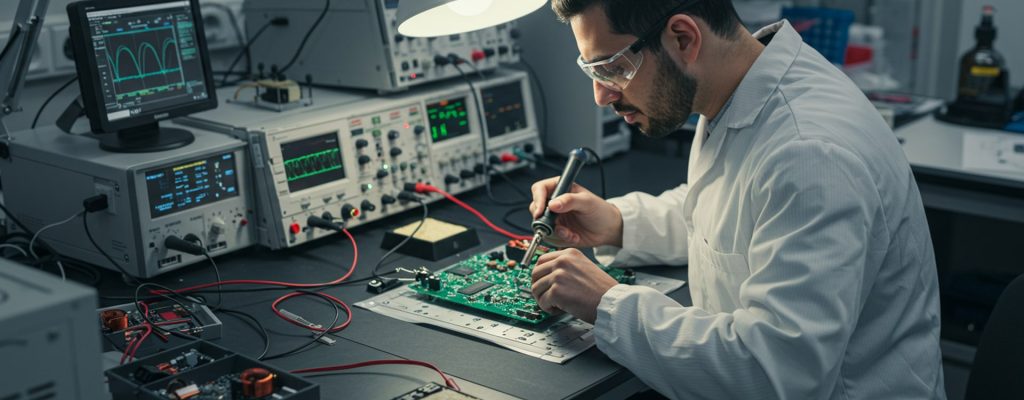
In industries ranging from medical devices to aerospace systems, qualification testing is an essential step in product development. These tests—focused on EMI scans, thermal cycling, vibration resistance, and mechanical durability—are critical for meeting compliance standards. However, they are often conducted under uniform or idealized lab conditions, which do not always mirror the extremes encountered in real-life environments.
📚 According to Michael Pecht, “standardized tests are essential but often do not adequately reflect the actual environment and usage profiles of the products.”
(Source: Pecht, M. (2009). Product Reliability, Maintainability, and Supportability Handbook)

For example, a telecommunications device may pass EMI testing in a lab environment, yet still be affected by dense electromagnetic noise in an urban deployment. Similarly, a rugged control unit that operates flawlessly in a thermal chamber may experience heat buildup in the field due to orientation, limited airflow, or enclosure constraints.
These are not oversights—they are limitations inherent in traditional testing frameworks. That’s why anticipating deployment-specific variables and engineering solutions accordingly has become a core part of how we work.
Why EMI, RFI, and Thermal Fatigue Go Unnoticed
While qualification tests validate performance under defined conditions, the reality is that EMI, RFI, and thermal fatigue behave differently across environments. EMI and RFI are especially context-sensitive: interference may result from nearby industrial equipment, transient electrical surges, or even wireless protocols not present during lab testing. Likewise, real-world thermal conditions—affected by ambient climate, device placement, and power density—can create hotspots and long-term stress that slowly degrade components over time.
📚 As emphasized by O’Connor & Kleyner, “real-world reliability is not guaranteed by passing qualification tests alone,” and understanding the true operating conditions is critical for accurate reliability prediction.
(Source: O’Connor, P.D.T., & Kleyner, A. (2012). Practical Reliability Engineering)

That’s why we place strong emphasis on understanding the actual deployment environment early in the design phase. Our application engineers collaborate with OEMs to ensure that the shielding and thermal materials specified will perform effectively not just in the lab—but over the full lifecycle of the product, in its intended setting.
In many cases, this approach enables devices to meet field performance requirements from the outset, while still allowing for adaptive refinements if new environmental variables emerge post-launch. By factoring in complex, real-world use cases, we help reduce long-term service calls, enhance product uptime, and protect brand reputation.

Customizing for the Real World Starts with Domestic Manufacturing
One of the most powerful enablers of this level of customization is domestic manufacturing. At Leader Tech, our U.S.-based production and engineering operations provide unmatched flexibility, speed, and collaboration. This proximity gives OEMs a tangible advantage—particularly when product timelines are compressed and application demands are evolving rapidly.
Why It Matters:
- Faster Iteration and Turnaround: Our domestic facility allows for rapid prototyping and short production cycles. Design feedback can be implemented within days—accelerating time to market without sacrificing performance validation.
- Design-Integrated Engineering: Customers have direct access to our application engineers, who collaborate on layout recommendations, material selection, and design enhancements based on the device’s actual use environment.
- Modified Standards at Scale: Unlike rigid offshore models, our approach allows for modified versions of standard shields, gaskets, and absorbers—without long tooling delays. This provides the performance of a custom product with the delivery speed of a catalog item.
- Compliance and Control: Our Tampa facility meets stringent regulatory and quality standards—including ITAR, ISO 9001, and RoHS—ensuring that sensitive industries can rely on us for full traceability and documentation.

📚 Research published in Harvard Business Review confirms that companies that manufacture closer to their design and deployment centers are better equipped to solve problems quickly and customize at scale.
(Source: Ferdows, K., Lewis, M.A., & Machuca, J.A.D. (2004). “Rapid-Fire Fulfillment.” Harvard Business Review)
For customers, the outcome is not just a product that works in theory—it’s a product that performs where it counts.
Proven in the Field: How Leader Tech Products Perform in Real-World Applications
Leader Tech’s shielding and thermal solutions are deployed across mission-critical applications where failure is not an option. While confidentiality agreements limit disclosure of specific customer names, the following examples are representative of how our products operate under real-world conditions:

🚀 Aerospace & Defense
In high-altitude avionics and ruggedized communications platforms, Beryllium Copper Fingerstock and custom Board-Level Shields are used to ensure both EMI suppression and mechanical resilience. These components are designed to maintain conductivity and compression under extreme temperature shifts and vibration—making them ideal for aerospace enclosures and military-grade hardware.
🏥 Medical Electronics
Our Thermally Conductive Absorbers (TCAs) and Conductive Elastomer gaskets have been integrated into diagnostic and imaging systems that must meet strict EMI containment standards (e.g., FCC Part 15, IEC 60601). These materials not only manage emissions but help protect critical readings from nearby wireless devices—ensuring uninterrupted patient care.


🏭 Industrial Controls
Programmable Logic Controllers (PLCs) used in harsh industrial settings often require complex shielding profiles to block high-frequency emissions from adjacent equipment. Our Fabric-Over-Foam Gaskets, cut to custom dimensions, provide consistent shielding and compression even under long-term stress and exposure to oil and dust.
🌐 Telecommunications & 5G
Outdoor 5G base stations and edge processing nodes benefit from Graphite Thermal gaskets capable of horizontal conductivity up to 400 W/m·K and vertical conductivity of 5.0 W/m·K. Combined with vented enclosures and hybrid EMI-thermal pads, these units maintain signal clarity and thermal stability in rooftop, roadside, and densely populated urban installations.

Conclusion: From Compliance to Confidence
Meeting compliance standards is a vital first step. But true product success depends on reliable performance in uncontrolled, real-world environments—environments where EMI, RFI, and thermal fatigue are not theoretical risks, but operational realities.
At Leader Tech, our commitment to domestic manufacturing, design-stage engineering collaboration, and field-proven materials ensures that our customers don’t just get a part—they get a partner. Together, we help move products from concept to deployment with confidence, clarity, and control.
As electronic systems continue to evolve—becoming more compact, powerful, and interconnected—the margin for error in shielding and thermal design grows smaller. Success depends on precise, environment-specific protection that starts early and adapts continuously. By working directly with our customers and maintaining tight control over our U.S.-based manufacturing processes, we provide not only robust performance, but also peace of mind. Because in today’s competitive market, it’s not just about passing a test—it’s about passing the test of time. Leader Tech is here to help you do exactly that.