


The continued rollout of 5G networks is reshaping how electronic systems are designed, deployed, and maintained. Higher operating frequencies, increased system density, and constant wireless connectivity are no longer edge cases—they are now standard expectations across many industries. As a result, EMI/RFI considerations have moved from a secondary concern to a central design requirement.
For shielding architects, this shift requires a more deliberate approach to EMI/RFI control. Solutions that once worked well at lower frequencies or in simpler systems often struggle to keep pace with the realities of modern 5G architectures. Understanding how 5G technologies—including higher-frequency implementations such as millimeter-wave (mmWave)—influence electromagnetic behavior is essential to designing systems that are reliable, manufacturable, and scalable.

How 5G Changes EMI/RFI Behavior
5G operates across a broader operating spectrum than previous wireless generations, combining familiar frequency ranges with higher-frequency implementations such as mmWave. This expanded range changes how electromagnetic energy behaves inside electronic systems, particularly within enclosures and at interface points.
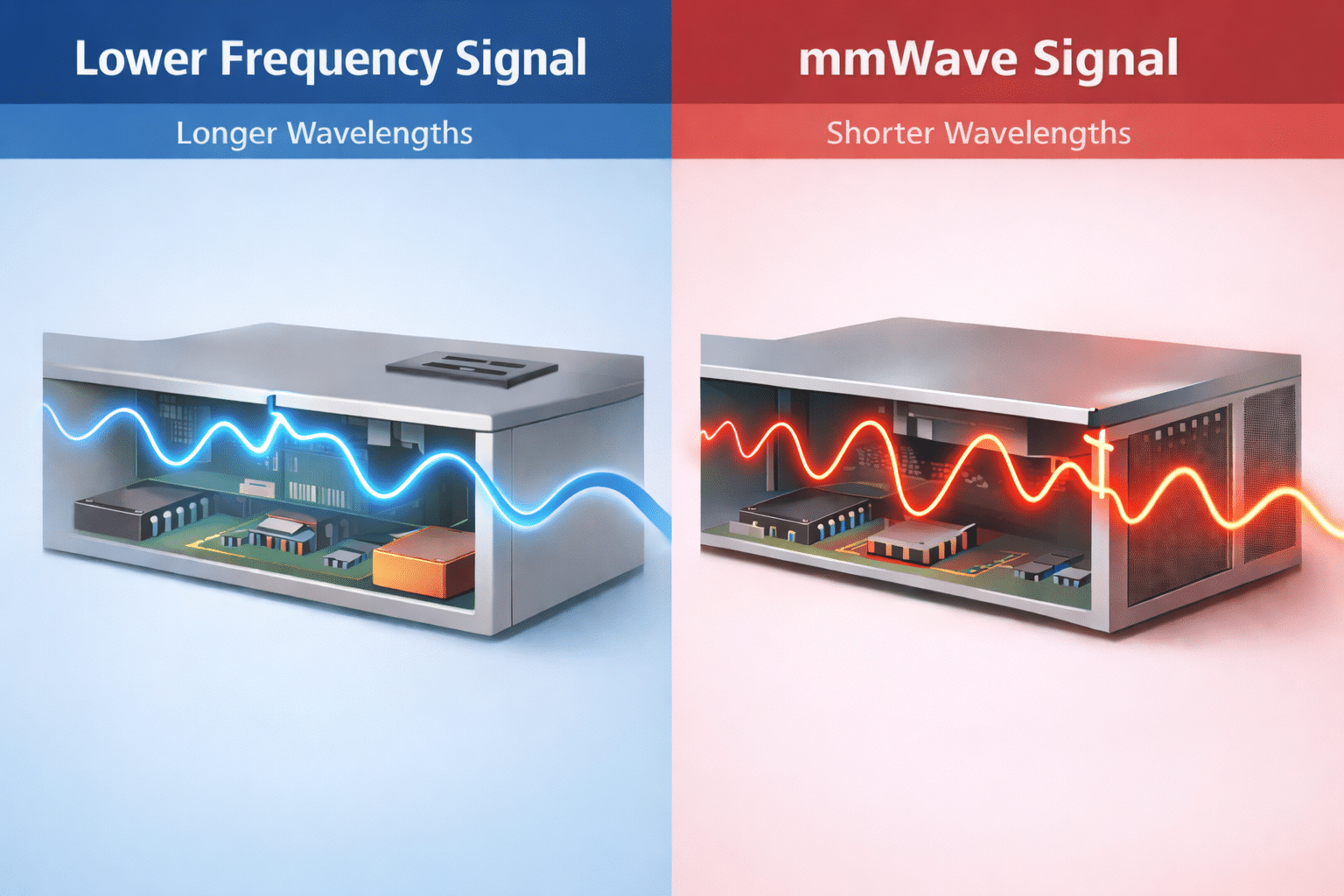
At higher frequencies, EMI/RFI becomes more sensitive to physical details that were once easier to manage. Seams, joints, and mating surfaces can act as unintended leakage paths if they are not carefully designed. Grounding paths that appear adequate at lower frequencies may no longer provide consistent performance across the full operating range of a 5G system.
Because of this, shielding can no longer be treated as an isolated layer applied to an otherwise complete design. Instead, it must be considered alongside mechanical layout, enclosure architecture, and grounding strategy. When these elements are addressed independently, inconsistencies often emerge that are difficult to correct later in development.
mmWave as Part of the 5G Landscape
Millimeter-wave technology is not separate from 5G, but rather a key part of its higher-frequency implementation. These shorter wavelengths intensify many of the EMI/RFI challenges already present in lower-frequency 5G systems, increasing sensitivity to small mechanical irregularities and discontinuities.
Within 5G networks, mmWave is commonly used in applications that demand extremely high data throughput and low latency over short distances. These include dense urban cellular deployments, fixed wireless access, indoor small cells, transportation hubs, stadiums, and industrial or campus-scale private networks. In these environments, compact equipment, closely spaced antennas, and dense electronics are often deployed in constrained enclosures, elevating the importance of precise EMI/RFI control.
In 5G systems that incorporate mmWave, small gaps or variations in contact pressure can have a noticeable impact on EMI/RFI containment. Interfaces that were previously considered acceptable may require tighter control to prevent unintended emissions or susceptibility. This places greater emphasis on how shielding elements are physically integrated into the enclosure and how they interact with adjacent components, particularly in infrastructure designed for high user density or continuous operation.
From a design standpoint, higher-frequency 5G environments reward solutions that are mechanically defined and repeatable. Shielding must function as part of the enclosure rather than as a loosely applied layer. This shift requires closer coordination between electrical, mechanical, and manufacturing teams to ensure that performance remains consistent from prototype through production, especially in mmWave-enabled systems deployed at scale.
Why Traditional Add-On Shielding Does Not Scale
Traditional add-on shielding approaches are typically introduced late in development, often in response to unexpected test results. These methods may include conductive tapes, sprayed coatings, hand-placed grounding elements, or generic shielding components added after layouts and enclosures are finalized.
While these approaches can be effective in limited situations, they are often difficult to control as designs move into full production. Performance may vary from unit to unit due to assembly differences, material handling, or environmental exposure. Over time, mechanical wear or repeated servicing can further degrade shielding effectiveness.
At higher frequencies used in 5G systems, the margin for error becomes smaller. Variations that were once negligible can have a measurable impact on EMI/RFI performance. This makes late-stage fixes increasingly risky, particularly for high-volume or long-life products. Scalable shielding strategies are those that are intentionally designed into the system and can be reproduced consistently across manufacturing runs.

Grounding as a System-Level Consideration
Effective EMI/RFI shielding cannot be separated from grounding. Even well-designed shielding elements can underperform if grounding paths are inconsistent or poorly defined. In modern 5G systems, grounding challenges often arise at interfaces between boards, enclosures, and removable panels.
Mechanical tolerances, vibration, and thermal movement can all affect grounding continuity over time. If these factors are not addressed early, shielding performance may degrade as systems age or undergo maintenance. This is particularly important in applications where 5G devices are expected to operate reliably for extended periods.
Treating grounding as a system-level design consideration helps ensure that shielding remains effective throughout the product lifecycle. When grounding paths are planned alongside shielding elements, designers gain greater control over both electrical and mechanical performance.
Designing for Real-World Deployment
Many 5G systems are deployed in environments that place additional stress on electronic hardware. Outdoor installations, industrial facilities, and infrastructure applications often expose devices to temperature changes, vibration, and environmental contaminants.
Shielding strategies must account for these conditions without compromising airflow, serviceability, or mechanical durability. Designs that perform well in controlled lab environments may struggle when exposed to real-world operating conditions. This makes durability and long-term stability just as important as initial EMI/RFI performance.
Considering deployment conditions early allows shielding architects to select approaches that balance performance with practicality. This reduces the likelihood of field failures and helps ensure that systems remain compliant and reliable over time.
EMI/RFI Shielding Products That Apply to These Architectures
A range of EMI/RFI shielding products can be applied to address the challenges found in 5G systems, inluding those that incorporate mmWave technology. The appropriate choice depends on frequency range, form factor, mechanical constraints, and manufacturing requirements.
Leader Tech offers a broad portfolio of shielding products that are commonly used in these types of architectures, including:
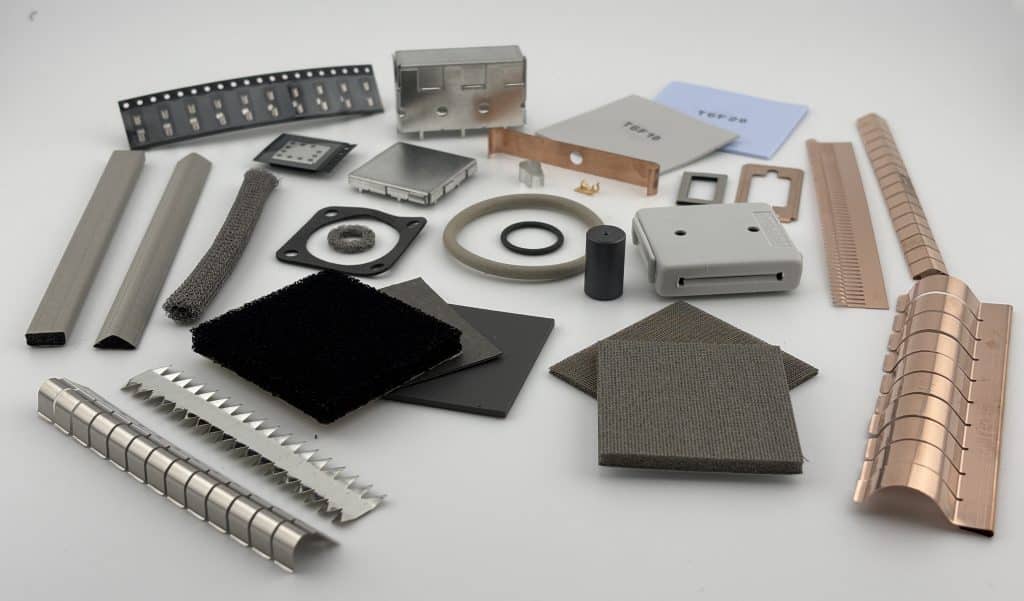
- Board-Level Shields, which are used to isolate sensitive components and reduce internal coupling on densely populated PCBs
- Conductive Elastomers, which are used at enclosure seams and interfaces to maintain electrical continuity while accommodating mechanical tolerances
- Fabric-Over-Foam and Conductive Gaskets, which are used to control EMI/RFI at doors, covers, and access panels
- Shielded Vent Panels, which are used where airflow or pressure equalization is required without compromising EMI/RFI integrity
- Spring Contacts and Fingerstock, which are used to maintain grounding continuity between boards, enclosures, and chassis components
These products are available in standard and customizable forms, allowing shielding architects to combine approaches based on the needs of each design rather than relying on a single solution.


Looking Ahead
As 5G networks continue to expand, EMI/RFI shielding will remain a foundational element of reliable system design. Higher frequencies, tighter integration, and more demanding deployment environments place greater responsibility on shielding architecture.
By moving beyond traditional add-on methods and adopting integrated, repeatable shielding strategies, design teams can better support performance, compliance, and long-term reliability. In this evolving landscape, thoughtful EMI/RFI planning is not just a technical requirement—it is a key factor in the success of next-generation connected systems.