

The drive toward lighter, stronger, and more efficient systems is reshaping industries from aerospace to automotive. At the forefront of this transformation are Structural Battery Composites (SBCs)—multifunctional materials that merge energy storage and structural strength into a single unit. Unlike traditional batteries that add weight without serving a mechanical purpose, SBCs integrate energy capacity into the structural framework of vehicles, drones, and even satellites.
This dual functionality is groundbreaking. By embedding batteries directly into load-bearing structures, SBCs promise significant reductions in overall system mass, while simultaneously freeing up space for other critical technologies. However, with such innovation comes a new set of engineering challenges—particularly in electromagnetic interference (EMI/RFI) shielding and thermal management.
The Versatility of Structural Battery Composites
What makes SBCs especially exciting is their versatility. They are not limited to a single industry or application.
- Aerospace: Aircraft manufacturers are investigating SBCs to reduce weight while increasing power availability for advanced avionics and electrified propulsion.
- Automotive: Electric vehicles benefit from lighter frames that extend range, while still housing the energy storage system.
- Defense & Military: Drones and portable power systems can become both structurally stronger and more energy-efficient.
- Consumer Electronics: Compact devices may one day integrate SBCs to minimize space taken up by batteries, enabling sleeker designs without sacrificing runtime.
In all these cases, SBCs highlight their core advantage: multifunctionality without compromise. But ensuring that embedded electronics remain reliable requires addressing two fundamental issues—EMI/RFI interference and thermal stress.

EMI/RFI Challenges in SBCs
Embedding electronics directly into structural materials inherently increases their exposure to electromagnetic interference. In traditional designs, electronic components are housed in isolated compartments where shielding can be more straightforward. With SBCs, however, the battery structure itself doubles as the electronics housing, which complicates isolation.
Potential EMI/RFI issues include:
- Cross-talk between embedded systems: High-density integration increases the chance of stray signals disrupting performance.
- Interference with external communications: Wireless systems in vehicles or aircraft could suffer from noise introduced by embedded electronics.
- Compromised safety systems: In mission-critical applications such as aerospace or defense, interference could endanger entire systems.
Addressing these requires shielding methods that are not bulky, do not add unnecessary weight, and can be integrated seamlessly with composite structures.

Thermal Challenges in SBCs
Equally important is the issue of heat management. SBCs must maintain both mechanical strength and battery efficiency, yet embedding electronics within structural materials limits airflow and natural cooling paths. Without proper thermal solutions, the risks include:
- Reduced battery lifespan: Excess heat accelerates chemical degradation in battery cells.
- Mechanical weakening: Elevated temperatures may compromise the structural integrity of composite materials.
- System instability: Heat buildup can trigger performance losses, unexpected shutdowns, or even safety hazards.
The challenge is to disperse heat efficiently without adding bulk or reducing the load-bearing benefits of the composite.
Solutions: Shielding and Thermal Versatility in Action
To ensure Structural Battery Composites (SBCs) achieve their full potential, shielding and thermal solutions must deliver reliable performance without adding unnecessary mass. Leader Tech offers a range of products that directly address these requirements:
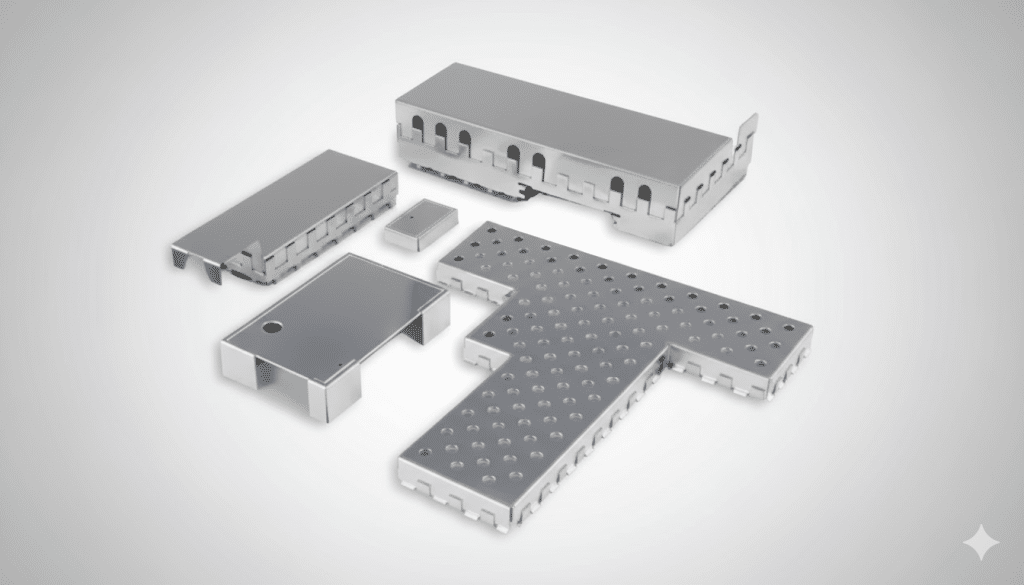
Leader Tech’s board-level shielding products are precision-engineered to protect sensitive components from EMI and RFI across a wide range of applications. Manufactured from high-quality materials such as pre-tin plated steel, nickel-silver, and other conductive alloys, these shields deliver dependable attenuation performance—up to approximately 60 dB, depending on the frequency range and configuration. Available in one-piece, two-piece, and custom slot-lok designs, they can be tailored with vent holes, pick-and-place tabs, or grounding features to suit any layout. Their lightweight construction and customizable geometry make them ideal for compact electronic assemblies where both space and signal integrity are critical.
Conductive Elastomer Interfaces
Leader Tech’s TechSIL elastomers conform to MIL-DTL-83528 standards and are available in more than a dozen compounds. Certain grades achieve up to 110 dB shielding effectiveness (20 MHz–10 GHz) and exhibit very low volume resistivity (on the order of milliohm-cm). These elastomers compress easily, maintain conductivity under stress, and adapt to complex geometries—making them ideal for EMI/RFI sealing within multifunctional SBC structures.


Fabric-over-foam gaskets combine a low-compression force foam core wrapped with a nickel/copper ripstop conductive fabric to create effective EMI/RFI seals at seams and access points. Leader Tech’s FSG products exhibit shielding effectiveness in the 80 to 115 dB range (per MIL-DTL-83528C), with surface resistivity under 0.05 Ω/in² and compression set below 15%. They endure from –40 °C up to +70 °C (or up to +135 °C in high-temp variants). In SBCs, these gaskets offer a lightweight, flexible, and electrically reliable solution for modular joints and serviceable interfaces without imposing significant weight or bulk.
Leader Tech’s ferrite cable shields are available in numerous form factors, including clamp-on sleeves and cable clamps. Depending on material and design, certain parts exhibit impedance values around 220 Ω at 100 MHz. This performance suppresses high-frequency noise on power and data lines routed through SBCs, preventing cables from acting as unintentional antennas while preserving signal integrity.

Thermal Solutions
Leader Tech’s high-performance thermal products are engineered to manage heat efficiently in demanding environments where compact designs and multifunctional performance are essential. The portfolio includes Thermal Gap Fillers (TGF), High-Performance Graphene Thermals (TGN Series), and Thermally Conductive Absorbers (TCA)—each addressing unique thermal and electromagnetic challenges.

TGF thermal gap fillers are available in multiple conductivity grades—for example, TGF80 offers 8.0 W/m·K, while TGF20-FG provides 2.0 W/m·K—delivering efficient heat transfer between components and surrounding structures. These materials allow the composite or housing to act as a passive heat sink, preventing localized hot spots and extending both component and structural lifespan.
High-Performance Graphene Thermals such as the TGN Series provide exceptional thermal conductivity, reaching up to 600 W/m·K in-plane (X direction) and up to 130 W/m·K through-plane (Z direction) for premium variants like TGN1300. Their thin construction (≈ 0.012 in / 0.3 mm) and low thermal resistance (as low as 0.050 °C·in²/W at 20 psi) make them ideal for compact, high-power applications. Designed for assemblies where power components generate concentrated heat loads, these materials deliver enhanced heat spreading across uneven surfaces while maintaining low thermal impedance.


Complementing these materials,Thermally Conductive Absorbers (TCA) combine heat dissipation and EMI absorption in one compact solution. Made from flexible, magnetically loaded silicone, they deliver thermal conductivities from 1.0 to 6.0 W/m·K and provide EMI attenuation across 1–40 GHz. This dual functionality allows them to manage both heat and electromagnetic noise at the source—ideal for compact, high-power designs where space and thermal performance are critical.
Versatility Beyond SBCs
The solutions designed for Structural Battery Composites are not limited to this emerging field. Their versatility extends across industries, addressing EMI/RFI and thermal challenges wherever compact, high-performance electronics are deployed. This adaptability highlights why Leader Tech’s products are widely trusted across critical sectors.
Aerospace and Defense
In aerospace platforms, weight reduction and reliability are always competing priorities. The same thin board-level shields used in SBCs can be applied to avionics modules, where dense electronics are packed into small enclosures exposed to vibration and fluctuating temperatures. Conductive elastomers provide EMI/RFI sealing at panel interfaces and maintain performance under altitude-induced pressure changes. For defense drones, ferrite cable shielding suppresses emissions on navigation and communication lines, preventing detection and interference during missions.
Automotive and Electric Vehicles
As vehicles incorporate advanced driver-assistance systems (ADAS), electric drivetrains, and 5G connectivity, EMI/RFI concerns multiply. Fabric-over-foam gaskets allow modular shielding around infotainment housings and sensor packages, maintaining reliable connectivity. Thermal pads serve as critical interfaces between high-power inverters and their cooling systems, reducing heat stress while maintaining compact form factors. This combination mirrors the demands of SBCs—integrating energy, electronics, and structure into a limited footprint.


Medical Technology
Medical equipment demands precision, safety, and reliability. Conductive elastomers are frequently used to seal sensitive diagnostic equipment from electromagnetic interference that could distort readings. Thermal gap fillers ensure imaging devices and portable diagnostic tools remain cool during prolonged operation, protecting delicate electronics and extending service life. In this field, the lightweight, flexible nature of these products makes them compatible with compact, ergonomic designs. Graphene-based thermal materials further enhance cooling and stability in compact medical electronics where precision and safety are critical.
Industrial IoT and Smart Infrastructure
Industrial IoT systems are deployed in environments with significant electrical noise and thermal stress. Ferrite shielding components suppress high-frequency interference in dense sensor networks, while board-level shields ensure clean signal integrity for embedded processors. In smart-grid infrastructure, conductive elastomer interfaces provide long-term EMI/RFI protection in outdoor enclosures exposed to temperature cycles and moisture, supporting reliable operation of energy distribution systems. Thermally Conductive Absorbers (TCA) also support these systems by combining EMI suppression with effective heat management in tight enclosures.
Consumer Electronics
Even at the consumer level, the principles remain the same. Smartphones, laptops, wearables, and gaming systems all face thermal and EMI/RFI constraints. Fabric-over-foam gaskets are used to reduce interference across enclosure seams, while thermal pads ensure processors and batteries remain cool without increasing bulk. By applying the same product families designed for aerospace or defense, consumer devices achieve higher reliability in sleek, portable packages.
This versatility mirrors the very principle of SBCs: combining multiple functions without compromise.

Looking Ahead: The Future of Multifunctional Materials
As industries demand ever-greater efficiency, SBCs will play a central role in redefining how we think about both batteries and structural design. But their success hinges on solving EMI/RFI and thermal challenges in ways that do not undermine their benefits.
The integration of board-level shields, conductive elastomer interfaces, thermal pads, and other integrated protection solutions, demonstrates how engineering versatility can keep pace with material innovation.
At the intersection of structural strength, energy storage, and signal integrity lies a new frontier—and with the right shielding and thermal strategies, SBCs can unlock their full potential across industries.