
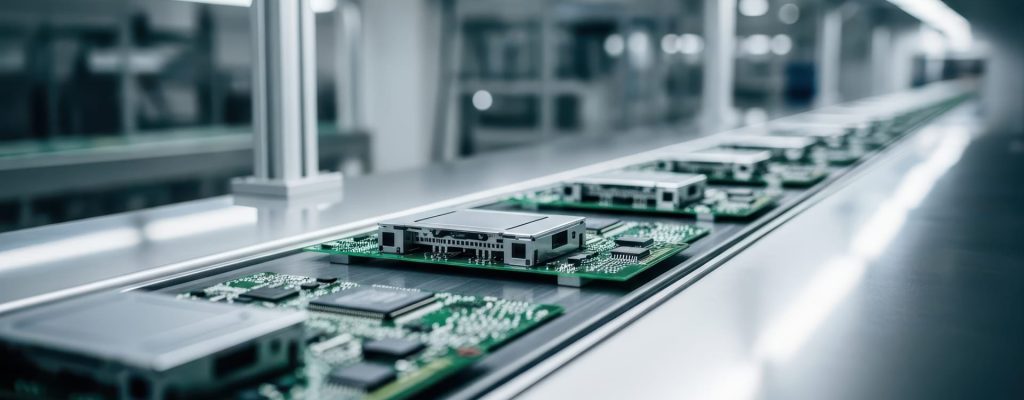
Moving a product from prototype to full-scale manufacturing is rarely as simple as building more units. Designs that perform well in the lab can reveal unexpected challenges once they reach the production floor, where assembly speed, repeatability, material availability, and quality control become just as important as electrical performance. This is especially true when it comes to designing for manufacturability in EMI/RFI shielding. Shielding solutions must not only provide reliable electromagnetic protection but also integrate smoothly into manufacturing processes without creating unnecessary complexity or delays.
Many production issues related to EMI/RFI shielding are avoidable. They often stem from design decisions made early in development, when factors such as assembly methods, component tolerances, and serviceability have not yet been fully considered. Addressing these considerations before a design is finalized can reduce manufacturing risks, shorten production timelines, and improve long-term product quality.
Why Manufacturability Matters in EMI/RFI Shielding
EMI/RFI shielding touches nearly every stage of product manufacturing. Board-level shields are installed during PCB assembly; conductive gaskets are integrated into enclosures, spring contacts require precise mechanical alignment, and cable suppression components are often added during final assembly. Each of these operations affects production efficiency.

A shielding solution that requires excessive manual adjustment, special tooling, or difficult installation procedures can increase labor time and introduce variability between assemblies. Even small inconsistencies may affect both shielding effectiveness and production throughput, leading to additional inspection, rework, or design revisions.
Designing with manufacturability in mind means selecting shielding solutions that balance electrical performance with ease of production, allowing products to move from prototype to volume manufacturing with fewer obstacles.

Mistake #1: Over-Specifying Custom Components
Custom shielding components are sometimes necessary for highly specialized applications, but they are often specified when standard or modified-standard solutions could achieve the same performance.
Fully custom shield cans, gasket profiles, or mechanical features typically require dedicated tooling, engineering validation, and extended qualification before production begins. These additional steps can increase non-recurring engineering (NRE) costs and lengthen project schedules.
Standardized components offer several advantages, including proven manufacturing processes, predictable lead times, and simplified procurement. In many cases, modified standard products can accommodate unique board layouts or enclosure geometries without requiring an entirely new design.
Leader Tech offers an extensive range of standard and modified-standard Board Level Shields, including its Slot-Lok™ system, allowing many applications to achieve custom-like functionality while minimizing tooling requirements and accelerating production readiness.

Mistake #2: Ignoring Manufacturing Tolerances
A design may appear perfect in CAD, yet small manufacturing variations can significantly affect shielding performance during production.
Printed circuit board thicknesses vary within manufacturing tolerances. Metal enclosures may experience slight dimensional changes during forming and finishing. Compression materials exhibit their own dimensional ranges, while fasteners and mounting hardware contribute additional stack-up variation.
When these tolerances are overlooked, shielding components may become over-compressed, under-compressed, or misaligned.
Potential consequences include:
- Inconsistent electrical grounding
- Reduced shielding effectiveness
- Difficulty assembling products
- Premature gasket wear
- Increased production rework
Designers should account for realistic manufacturing tolerances rather than relying solely on nominal dimensions.
Leader Tech’s conductive elastomers, Fabric-over-Foam gaskets, and Beryllium Copper Fingerstock products are available in numerous profiles and compression ranges, allowing designers to select solutions better suited for expected manufacturing variation.

Mistake #3: Making Shielding Difficult to Assemble
Every additional assembly step will increase production time.
Shielding designs that require specialized installation techniques, difficult alignment, or multiple fastening operations can slow assembly lines and increase opportunities for operator error.
Examples include:
- Shield cans with limited installation access
- Components requiring special fixtures
- Multiple loose hardware pieces
- Designs that demand precise manual alignment
- Installation sequences that interfere with adjacent components
These challenges become increasingly significant during high-volume production, where even a few additional seconds per assembly can translate into substantial labor costs over thousands of units.
Simplifying installation improves consistency while reducing manufacturing complexity.
Leader Tech’s Slot-Lok™ and Surface Mount Shields (SMS) systems are designed to support straightforward installation and removal, making it easier to assemble, inspect, and rework PCB shielding throughout the product lifecycle.


Mistake #4: Overlooking Inspection, Testing, and Rework
Manufacturing does not end when the last component is installed.
Products frequently undergo electrical testing, functional verification, firmware programming, and quality inspections before shipment. During these processes, technicians may need temporary access to shielded components.
If shielding must be cut, destroyed, or permanently removed to reach the underlying circuitry, rework becomes slower, more expensive, and less reliable.

Similarly, products requiring field service or future upgrades benefit from shielding solutions that can be removed and reinstalled without compromising performance.
Considering accessibility during the design phase can reduce repair costs while supporting long-term product maintainability.
Removable board-level shielding solutions, including modular systems such as Slot-Lok™, help simplify inspection and service without requiring complete replacement after each access cycle.
Mistake #5: Treating EMI/RFI Shielding as a Final Step
One of the most common causes of production delays is waiting until late in the design process to address EMI/RFI shielding.
By the time compliance testing identifies unwanted emissions or susceptibility issues, enclosure dimensions, PCB layouts, connector locations, and mechanical clearances are often already fixed.
Adding shielding at this stage frequently requires:

- PCB redesigns
- Mechanical modifications
- New enclosure tooling
- Additional prototype iterations
- Delayed certification testing
Considering shielding requirements from the beginning allows electrical, mechanical, and manufacturing teams to optimize designs together rather than solving problems after they appear.
Early collaboration also helps identify standard shielding solutions that fit naturally within the overall product architecture.
Designing for Manufacturability from the Beginning
Manufacturable shielding designs are rarely the result of a single design decision. Instead, they reflect careful coordination between electrical performance, mechanical integration, and production efficiency.
Several practices can help reduce manufacturing risks:
- Use standard or modified-standard shielding products whenever practical.
- Allow for realistic manufacturing tolerances and compression ranges.
- Minimize assembly complexity by reducing unnecessary installation steps.
- Design shielding that supports inspection, testing, and future service.
- Consider shielding requirements early in PCB and enclosure development.
- Work with shielding specialists before designs are finalized.
These practices can reduce engineering changes later in development while improving production consistency and overall product reliability.

How Leader Tech Supports Manufacturable EMI/RFI Designs
Designing for manufacturability extends beyond selecting individual shielding components. It also involves choosing a partner capable of supporting projects from early development through production.
Leader Tech manufactures approximately 95% of its products in the United States, helping customers benefit from stable supply chains, shorter lead times, and consistent production quality. Our broad portfolio of Board Level Shields, conductive elastomers, Fabric-over-Foam gaskets, Beryllium Copper Fingerstock, ferrite cable shielding solutions, and other EMI/RFI products provides engineers with numerous standard options before custom designs become necessary.
When application requirements extend beyond standard offerings, our engineering team can modify existing product designs to better match mechanical constraints while avoiding the time and expense often associated with fully custom solutions. This approach helps streamline product development while maintaining the manufacturing efficiency needed for successful production.
Effective EMI/RFI shielding is measured by more than compliance test results. A design that performs exceptionally in the laboratory can still create costly production challenges if manufacturability is overlooked.
By considering manufacturing tolerances, assembly methods, inspection requirements, and serviceability early in development, design teams can reduce delays, simplify production, and improve product consistency. Standard and modified-standard shielding solutions, thoughtful mechanical integration, and early collaboration all contribute to smoother transitions from prototype to production.
As electronic systems continue to grow more compact and complex, designing for manufacturability will remain an essential part of successful EMI/RFI shielding—helping products reach the market faster while maintaining the performance and reliability customers expect.