USA-Made

The Birth of the Integrated Circuit: Kilby, Noyce, and the Path to Modern Electronics

Kilby and Noyce Cover

In the late 1950s, electronics faced a problem that no incremental improvement could solve. Circuits were growing more complex by the year, requiring thousands of individual components—transistors, resistors, capacitors—each wired together by hand. As systems expanded, so did their fragility. Failures became more frequent, assembly more difficult, and signal integrity harder to maintain. Engineers referred to it as the “tyranny of numbers.”

At its core, the challenge was not just scale—it was complexity. And while interference and signal degradation were already present concerns, they were still largely manageable in systems built from discrete parts. That would soon change.

What followed was not just a breakthrough in design, but a transformation in how electronics would behave forever:

Miniaturization → Density → Interference → Need for EMI/RFI control

This chain begins with two names: Jack Kilby and Robert Noyce.

Black PCB

Jack Kilby: Proving It Could Be Done

In 1958, while working at Texas Instruments, Jack Kilby approached the problem from a radically different angle. Instead of improving how components were connected, he asked a more fundamental question:

What if the components didn’t need to be separate at all?

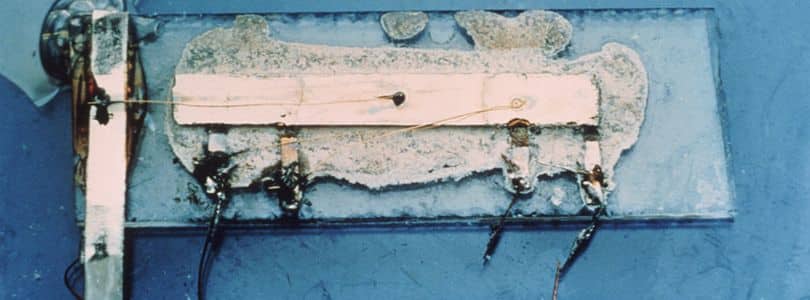
Kilby’s answer was the first integrated circuit—a simple device built on a single piece of germanium that combined multiple electronic elements into one structure. It was assembled by hand, with fine wires connecting the components etched into the material.

It worked.

That alone was enough to change the direction of electronics.

Kilby had demonstrated that integration was not just theoretical—it was possible. But his design came with limitations. It was difficult to manufacture, not easily scalable, and relied on techniques that weren’t suited for mass production.

Still, the conceptual leap was enormous.

Kilby didn’t solve the industry’s problem—but he proved there was a solution to be found.

Kilby's First IC
The first Integrated Circuit, designed by Kilby. Image sourced from: dpma.de

Robert Noyce: Making It Practical

Just a year later, Robert Noyce at Fairchild Semiconductor took the idea further.

Where Kilby’s approach showed what could be done, Noyce focused on how it could be done at scale.

Using silicon instead of germanium, and building on the emerging planar process, Noyce developed a method to fabricate integrated circuits in a way that allowed for consistency, repeatability, and mass production. Crucially, he introduced a technique for creating interconnections directly on the chip using deposited metal layers.

This eliminated the need for hand-wiring and made the integrated circuit manufacturable.

If Kilby proved the concept, Noyce made it viable.

With that, the trajectory of electronics changed permanently.

Jack Kilby
Jack Kilby (1923-2005). Image sourced from: americanhistory.si.edu
Robert Noyce
Robert Noyce (1927-1990). Image: Dan Mccoy/The LIFE Images Collection/Getty Images

Miniaturization: More Than Just Smaller Devices

The immediate impact of the integrated circuit was obvious—electronics became smaller. Devices that once filled rooms could now fit on a desktop, and eventually in the palm of a hand.

But miniaturization did more than reduce size. It fundamentally altered how electronic systems were structured.

Instead of spreading components across space, integration compressed them into tightly packed environments. Distances between conductive paths shrank. Signal paths became shorter. Switching speeds increased as devices became more efficient.

At first glance, this seemed like simplification.

In reality, it was the beginning of something far more complex.

Kilby Patent

Density: Complexity in a Smaller Space

As integrated circuits evolved, the number of components per chip grew exponentially. What began as a handful of elements quickly expanded into thousands, then millions, and now billions of transistors on a single die.

This increase in density brought undeniable benefits—greater processing power, faster performance, and reduced energy consumption per operation. But it also introduced new challenges that were not present in earlier, discrete systems.

Components were no longer isolated. They existed in close proximity, sharing space, power, and electromagnetic environments.

And that proximity changed everything.

Miniaturization didn’t eliminate complexityit compressed it.

Early Board
A 1970s circuit board at a time when integration was advancing rapidly—components becoming denser, layouts more compact, and the challenges of signal integrity and interference beginning to take shape.

The Need for EMI/RFI Control

As density increased and interference became internalized, the need for EMI/RFI control evolved from a secondary consideration into a fundamental design requirement.

Engineers began developing new strategies to manage these effects:

  • Localized shielding to isolate sensitive components
  • Grounding techniques to control unwanted currents
  • Material innovations to contain and dissipate electromagnetic energy
  • Thermal management solutions to address heat generated by dense, high-speed operation

These approaches were not optional enhancements—they became essential to maintaining performance, reliability, and compliance in modern electronics.

At the same time, thermal challenges emerged alongside electromagnetic ones. As more functionality was packed into smaller spaces, heat generation increased, requiring equally advanced methods of dissipation and control.

The integrated circuit didn’t just introduce new capabilities—it introduced new constraints.

Early NCTR Computer
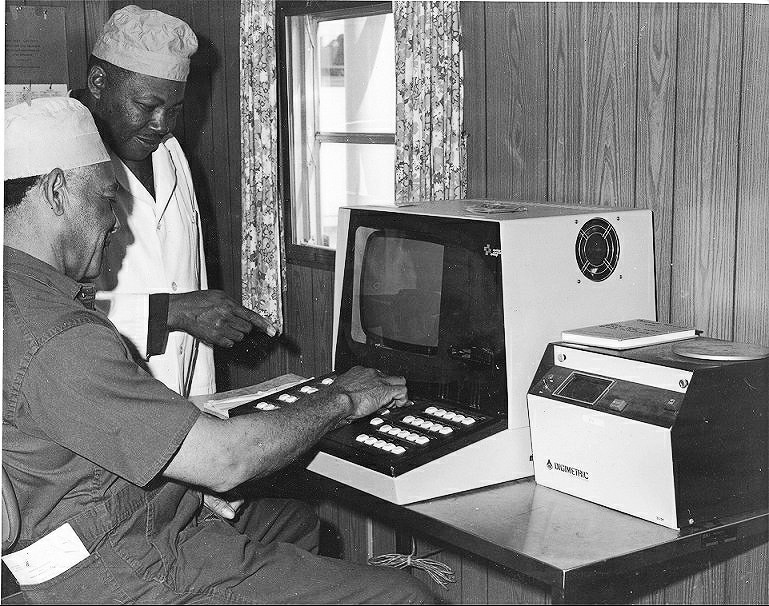
A look back at early computer terminals in 1973—when electronics were still transitioning from large, discrete systems toward the integrated, high-density technologies that define modern computing today.

Supporting Technologies in a Densely Integrated World

As electronic systems continued to evolve, so did the technologies designed to support them.

Board-level shielding solutions became critical for isolating high-frequency components within compact layouts. Conductive materials, including elastomers, provided effective grounding and environmental sealing in applications where space was limited and reliability was essential. Advances in thermal interface materials—particularly those leveraging graphene—offered new ways to manage heat in increasingly dense architectures.

These developments reflect a broader reality:

As integration increases, supporting technologies must evolve in parallel to maintain system integrity.

ENCLOSURE SHIELDING
products
Board Level Shielding with Leader Tech Inc

A Lasting Impact

Today’s electronic landscape—from smartphones and data centers to electric vehicles and advanced communication systems—exists because of the foundation laid by Kilby and Noyce.

Modern devices operate at speeds and densities that would have been unimaginable in the 1950s. Yet the challenges introduced by integration remain central to their design.

Signal integrity, thermal management, and EMI/RFI control are no longer peripheral concerns—they are integral to the functionality of every advanced electronic system.

Kilby and Noyce did more than reduce the size of circuits.

They changed the conditions under which electronics operate.

High Performance Custom Gaming Computer
From early terminals to modern gaming rigs—the evolution of electronics tells a clear story: miniaturization led to density, density introduced new challenges, and today’s performance is built on decades of innovation in integration and control.

Conclusion: Integration Was Only the Beginning

The invention of the integrated circuit is often remembered as a story of miniaturization. But its deeper impact lies in how it reshaped the behavior of electronic systems.

By bringing components closer together, Kilby and Noyce set in motion a chain reaction:

Miniaturization → Density → Interference → Need for EMI/RFI control

What began as a solution to the tyranny of numbers became the foundation for modern engineering challenges.

The integrated circuit didn’t eliminate complexity.

It concentrated it.

And in doing so, it defined the path forward for every generation of electronics that followed.

LinkedIn
X
Facebook
Email
David Mendez Galpern
Leader Tech EMI/RFI Shielding integrated into aerospace applications

Subscribe to receive our newsletters and product updates

This field is for validation purposes and should be left unchanged.
Leader Tech Inc needs the email address you provided to send you our newsletters and product updates. You may unsubscribe from these communications at any time.
Archives
×

Rep Firm