

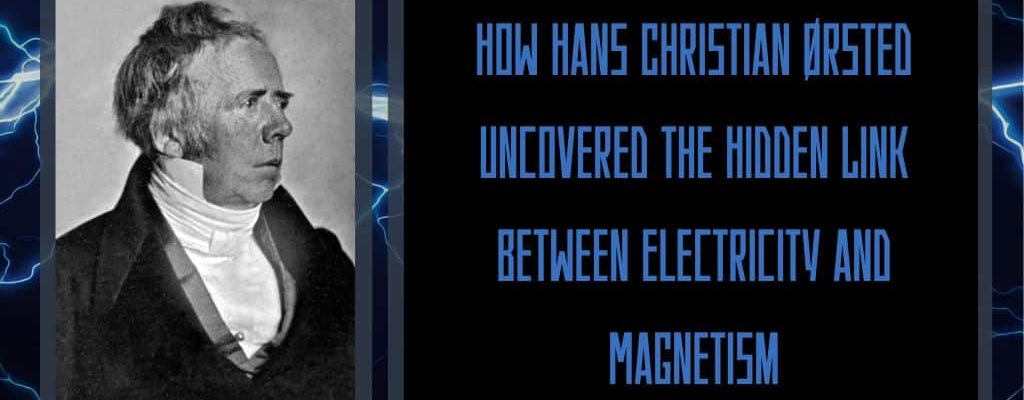
The Moment That Changed Physics Forever
In the early 19th century, the world of science was still grappling with the mysteries of electricity and magnetism. They were seen as entirely separate forces, governed by different rules and possessing no obvious connection. Then, in 1820, a Danish physicist named Hans Christian Ørsted changed everything.
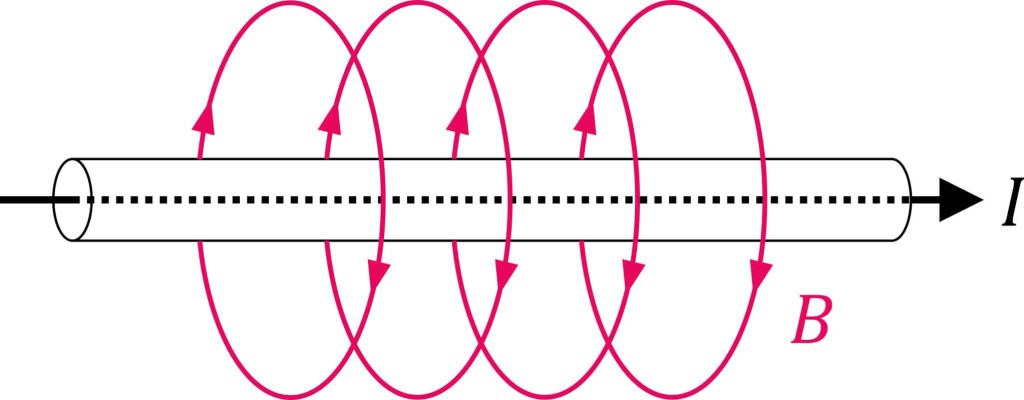
During a routine lecture demonstration, Ørsted passed an electric current through a wire placed near a compass. To his astonishment, the compass needle deflected each time the current flowed. What had seemed like an isolated curiosity at first glance quickly revealed itself as a revolutionary discovery: electric currents create magnetic fields.
This simple observation bridged two previously distinct domains of natural science, giving birth to what we now know as Electromagnetism. It is no exaggeration to say that Ørsted’s discovery marked the starting point of the electrical age. Without it, the modern world of electronics, power grids, wireless communication, and even the shielding technologies that protect these systems could not exist.
Bridging Two Worlds with a Single Wire
To understand the magnitude of Ørsted’s discovery, it helps to picture the state of science in 1820. Static electricity was a known curiosity—sparks from rubbed amber or glass rods—but its behavior was mysterious. Magnetism, on the other hand, was associated with lodestones and compass navigation. Few suspected the two phenomena were related.
Ørsted’s experiment changed this. As he lectured students, he noticed that a magnetic compass placed near a current-carrying wire would consistently deflect when the circuit was closed and return to its normal position when the circuit opened. He repeated the test multiple times to be certain: the deflection always coincided with the presence of current.
Crucially, Ørsted interpreted what he saw correctly. He deduced that an electric current generates a magnetic field that circles around the wire, invisible yet real. This insight was radical at the time and attracted immediate attention from Europe’s leading scientists. It inspired André-Marie Ampère to formalize the laws of electrodynamics within a year, and it later provided the foundation for James Clerk Maxwell to unify electricity, magnetism, and light into a single theoretical framework.


From Compass Needles to Powering Civilization
Ørsted’s discovery did more than connect two forces — it opened the door to a technological revolution. The link between electricity and magnetism made it possible to build the first Electromagnet, a coil of wire that becomes magnetized when current flows through it. This seemingly simple concept became the building block for countless devices: electric motors, generators, transformers, and relays.
These inventions turned electricity from a laboratory curiosity into a practical power source, driving the rise of industry, communication, and transportation. Every modern electronic system — from smartphones to spacecraft — ultimately depends on the electromagnetic principles Ørsted revealed.
Even the delicate printed circuit boards inside today’s high-speed devices are shaped by his legacy. Their design must account for the electromagnetic fields generated by the flow of current, ensuring those fields are controlled and contained. That design consideration exists because Ørsted first proved those fields exist.


The Shielding Connection: Managing the Fields Ørsted Discovered
Ørsted’s discovery also revealed a challenge that modern engineers continue to wrestle with: electromagnetic interference (EMI) and radio frequency interference (RFI). Because electric currents naturally produce magnetic fields, they can unintentionally radiate energy into nearby circuits. In densely packed electronic systems, this interference can cause malfunctions, data errors, and signal degradation.
This is where the work of companies like Leader Tech becomes essential. Shielding technologies are specifically designed to contain or block the electromagnetic fields that Ørsted first observed.
Board-Level Shields isolate sensitive circuits to prevent cross-talk from adjacent components.
Conductive Elastomers form tight seals around enclosures to block unwanted emissions while protecting against environmental elements.
Fabric-Over-Foam Gaskets provide reliable EMI/RFI shielding along seams in enclosures while maintaining flexibility.
Thermal Interface Materials ensure that heat generated by high-frequency circuits is dissipated efficiently, preserving reliability even as devices push the limits of power density.

These solutions embody the modern engineering response to Ørsted’s discovery. They don’t just use the principles he uncovered — they actively control them, allowing electronics to operate reliably in an increasingly electromagnetic world.
A Broader Legacy Beyond Electromagnetism
Though his fame rests primarily on his work with electromagnetism, Ørsted’s influence extended beyond physics. He was a true polymath: a chemist who isolated the element Aluminium in 1825, and a philosopher who championed the unity of nature. His writings emphasized that the laws of the natural world were interconnected, an idea reflected in his landmark experiment linking electricity and magnetism.
Ørsted also played a central role in Danish scientific education. He founded the Danish Society for the Dissemination of Natural Science and helped establish the Technical University of Denmark, inspiring generations of scientists and engineers. His dedication to public science outreach helped transform Denmark into a center of scientific thought in the 19th century.
In recognition of his contributions, the unit of magnetic field strength in the CGS system — the Oersted (Oe) — was named in his honor. Every time an engineer measures magnetic fields, they invoke his name, often without realizing it.

From Ørsted to the Future
More than 200 years after his discovery, Ørsted’s legacy pulses through every wire that carries current. His experiment with a compass needle and a wire continues to shape the design of everything from microchips to massive power transformers. It also frames the modern challenges of EMI/RFI control and thermal management that engineers must solve as electronic devices grow smaller, faster, and more powerful.
Companies like Leader Tech operate on the cutting edge of this ongoing story. Their shielding products and thermal interface materials are modern tools for managing the electromagnetic forces Ørsted first revealed. When electronic devices are protected from interference, when heat is dissipated to keep circuits stable, when data flows reliably through complex systems — Ørsted’s influence is quietly at work in the background.
He showed that nature’s forces are connected. Today’s engineers extend that insight, designing systems that balance those forces rather than fighting them. The invisible magnetic field that nudged a compass needle in Ørsted’s lab has grown into the foundation of the connected world — and our ability to shield, guide, and control that energy is part of his enduring legacy.

Conclusion — A Compass Pointing Forward
Hans Christian Ørsted didn’t set out to revolutionize science that day in 1820. He was simply demonstrating a principle to students when he made an observation that reshaped the future. His discovery that electric currents create magnetic fields gave rise to electromagnetism, unlocked the age of electrical technology, and laid the groundwork for the modern electronics that define our lives.
Every piece of shielding and every thermal solution that protects today’s devices stands as quiet proof of his insight. The invisible forces Ørsted discovered are still all around us — and our ability to control them is what makes progress possible. His compass needle, once deflected by a passing current, still points the way forward.